Walk into almost any traditional Hindu home, and you’ll notice something remarkable.
Before entering the house…
Before looking at the decorations…
Before even greeting the family…
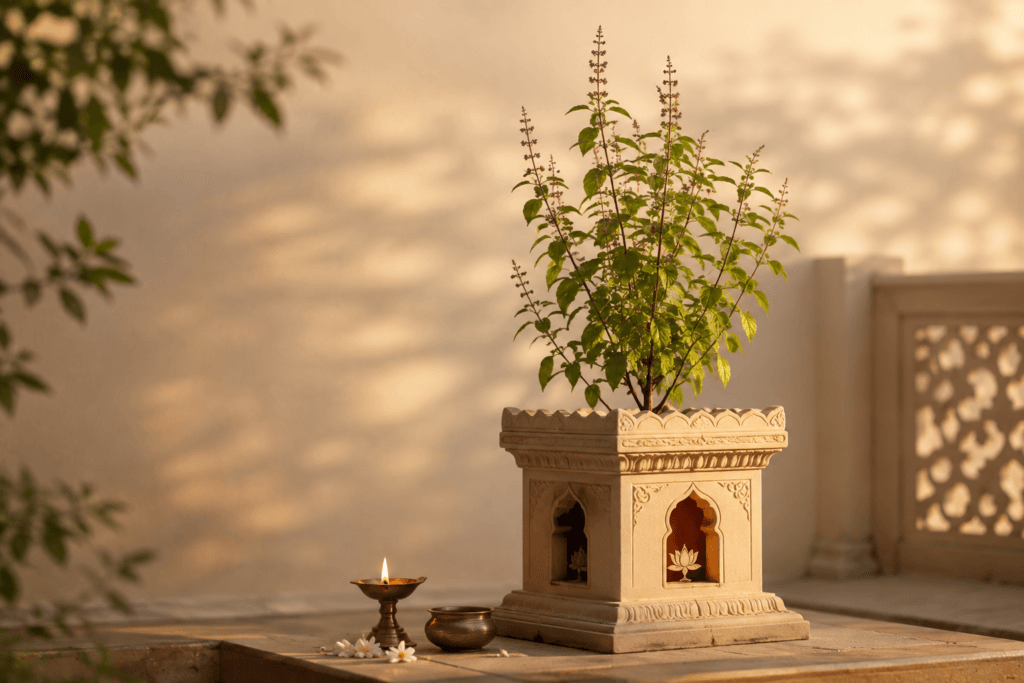
Your eyes often fall upon a small green plant growing in the courtyard or balcony.
It isn’t there for decoration.
It isn’t planted because of its fragrance.
It isn’t simply another medicinal herb.
It is Tulsi—one of the most sacred plants in Sanatan Dharma.
But have you ever stopped and asked yourself…
Why is Tulsi worshipped every single day?
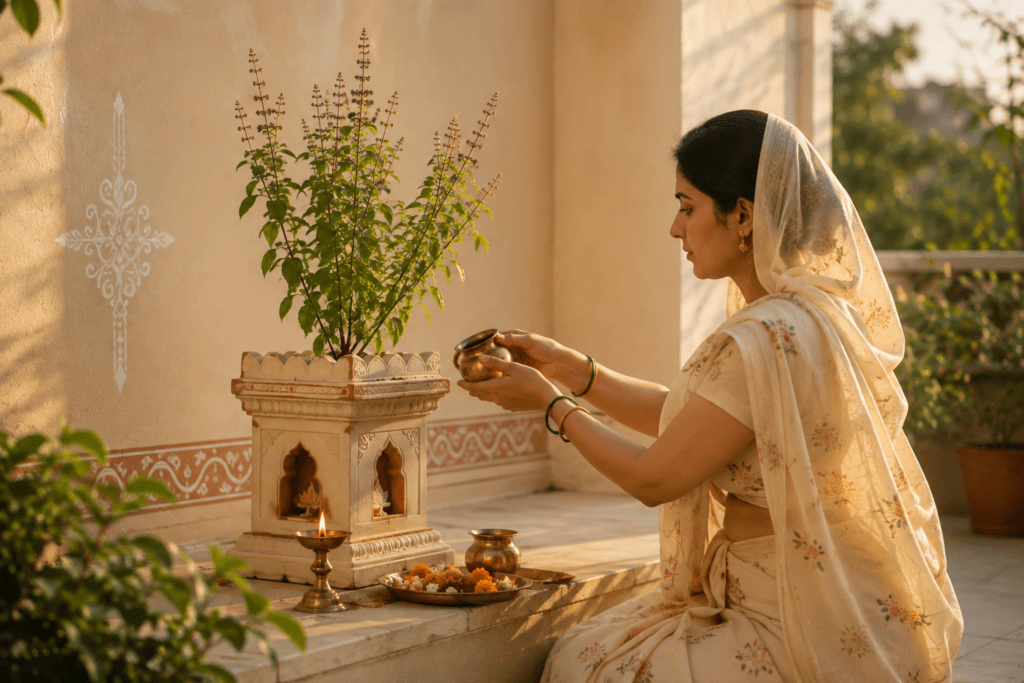
Why do millions of devotees offer water to Tulsi every morning?
Why is a lamp lit beside the plant during sunset?
Why do ancient scriptures describe Tulsi as a goddess rather than an ordinary plant?
And why is it believed that a house without Tulsi feels spiritually incomplete?
The answers are far more fascinating than most people realize.
Many people think Tulsi worship is only a tradition passed down by elders.
But behind this simple ritual lies an extraordinary combination of spirituality, devotion, symbolism, Ayurveda, and even science.
Every leaf carries a story.
Every ritual has a purpose.
Every prayer reveals a deeper truth.
By the end of this three-part journey, you’ll discover why Tulsi has been revered for thousands of years and why her importance continues to grow even in today’s modern world.
But before we uncover the first powerful reason…
We need to understand one question that changes everything.
Why Is Tulsi Worshipped: Is Tulsi Really Just a Plant?
Imagine someone calling the Ganga “just water.”
Or describing a temple as “just a building.”
Technically, those statements may sound correct.
Spiritually, they couldn’t be further from the truth.
The same applies to Tulsi.
To the eye…
She is a plant.
To Sanatan Dharma…
She is far more.
Ancient scriptures describe Tulsi as Vrinda Devi, a divine manifestation of purity, devotion, and unwavering faith.
Unlike ordinary plants, Tulsi is worshipped with folded hands.
She receives offerings.
She is circumambulated.
Festivals are celebrated in her honor.
Even marriages are performed between Tulsi and Lord Vishnu during Tulsi Vivah.
Think about that.
No ordinary plant receives such reverence.
This naturally raises another question.
What made Tulsi so sacred that generations have continued worshipping her for thousands of years?
Let’s begin discovering the answer.
Why Is Tulsi Worshipped #1: Tulsi Represents Pure Devotion
Every great spiritual tradition has one quality that stands above all others.
Devotion.
Not wealth.
Not power.
Not knowledge.
Devotion.
Tulsi symbolizes exactly that.
According to sacred scriptures, Vrinda Devi possessed such unwavering devotion that even the gods admired her purity.
Her faith remained unshaken despite unimaginable hardships.
That devotion eventually transformed her into the sacred Tulsi plant, forever becoming beloved to Lord Vishnu.
This is why devotees never see Tulsi as ordinary vegetation.
She reminds us that sincere devotion has the power to transform an ordinary life into an extraordinary one.
Today’s world often teaches us to chase success.
Tulsi quietly teaches us to nurture faith.
Because when devotion becomes sincere…
The Divine naturally comes closer.
Why Is Tulsi Worshipped #2: Every Home Becomes Spiritually Alive
Have you noticed something unique about homes that have a Tulsi plant?
There is a certain calmness.
A quiet energy.
An atmosphere that feels peaceful.
For centuries, elders have believed that Tulsi attracts positive vibrations while reducing negativity around the home.
Whether one views this spiritually or psychologically, the impact is undeniable.
Daily rituals around Tulsi naturally create discipline.
Families gather.
Prayers are offered.
A diya is lit.
Moments of gratitude become part of everyday life.
These simple habits slowly transform a house into a home filled with devotion.
Perhaps this is why ancient households rarely existed without Tulsi.
She wasn’t merely planted.
She became the spiritual heart of the family.
Why Is Tulsi Worshipped #3: Lord Vishnu Never Accepts Worship Without Tulsi
This may surprise many people.
According to several Hindu scriptures, offerings made to Lord Vishnu are considered incomplete without Tulsi leaves.
Whether it is Satyanarayan Katha…
Ekadashi…
Janmashtami…
Or daily Vishnu Puja…
Tulsi occupies a central place.
But why?
Because Tulsi represents pure love.
When a devotee offers Tulsi, they are not simply offering leaves.
They are offering sincerity.
Faith.
Humility.
And complete surrender.
Scriptures repeatedly remind us that the Divine looks beyond expensive offerings.
The purity of the heart matters far more.
A single Tulsi leaf offered with genuine devotion is considered more valuable than countless luxurious offerings made without faith.
That lesson remains timeless.
Why Is Tulsi Worshipped #4: Tulsi Connects Nature with Spirituality
Modern society often separates nature from religion.
Ancient India never did.
The sages understood something extraordinary.
Nature itself is sacred.
Mountains.
Rivers.
Trees.
Animals.
Plants.
Each plays a role in maintaining life’s balance.
Tulsi became one of the greatest examples of this philosophy.
By worshipping a living plant every day, people unknowingly developed respect for nature.
Instead of exploiting the environment, they learned to protect it.
Long before environmental awareness became a global movement…
Sanatan Dharma was already teaching ecological responsibility through simple daily rituals.
Perhaps Tulsi worship was never only about religion.
Perhaps it was humanity’s earliest lesson in living harmoniously with nature.
Why Is Tulsi Worshipped #5: The Sacred Plant That Heals Body and Mind
There is another reason Tulsi occupies such a special place.
One that bridges spirituality and science.
For thousands of years, Ayurveda has praised Tulsi as one of nature’s greatest medicinal herbs.
Its leaves have traditionally been used to support immunity, respiratory health, digestion, and overall well-being.
Even today, modern researchers continue studying Tulsi for its remarkable natural properties.
Isn’t it fascinating?
A plant worshipped in temples also finds its place in traditional healing.
This beautiful harmony reminds us that ancient wisdom often combined physical health with spiritual well-being.
When the body becomes healthier…
The mind becomes calmer.
When the mind becomes calmer…
Prayer becomes deeper.
Perhaps this is why Tulsi has always been seen as a complete blessing.
Not only for the soul…
But for life itself.
Why Is Tulsi Worshipped: A Secret Still Remains…
So far, we’ve discovered that Tulsi represents devotion…
Transforms the energy of a home…
Holds a sacred place in Lord Vishnu’s worship…
Connects humanity with nature…
And supports both spiritual and physical well-being.
But the most fascinating mysteries are still waiting.
Why is Tulsi Vivah celebrated like a real wedding?
Why should Tulsi leaves never be plucked on certain days?
What spiritual significance lies behind offering water to Tulsi every morning?
And why do ancient scriptures say that even Yama, the God of Death, respects the presence of Tulsi?
The answers reveal a side of Tulsi that many devotees have never heard before.
Tulsi Worship Significance: Ancient Secrets That Most People Have Never Heard
By now, one truth has become impossible to ignore.
Tulsi is not simply a sacred plant.
She is a living symbol of devotion.
Every morning, millions of devotees offer water to Tulsi.
Every evening, they light a diya beside her.
Children grow up watching these rituals.
Many continue them throughout their lives.
But surprisingly…
Very few know why these traditions exist.
Why shouldn’t Tulsi leaves be plucked at night?
Why is Tulsi Vivah celebrated with music, prayers, and wedding rituals?
Why do scriptures say that even death hesitates before a true Tulsi devotee?
The deeper you explore these questions…
The more fascinating Tulsi becomes.
Let’s continue the journey.
Tulsi Worship Significance: Why Every Ritual Around Tulsi Has a Hidden Meaning
In Sanatan Dharma, rituals were never created without purpose.
Every action carries symbolism.
Lighting a diya is not merely about fire.
Offering water is not only about nourishment.
Walking around Tulsi is not simply a tradition.
Each ritual quietly trains the mind.
Discipline.
Gratitude.
Patience.
Mindfulness.
Faith.
Without realizing it, these simple daily practices slowly transform human character.
Perhaps this explains why ancient sages never separated spirituality from everyday life.
Even watering a plant became an act of worship.
6. Tulsi Vivah Teaches That Devotion Leads to Divine Union
Every year, during the month of Kartik, something extraordinary happens.
Homes and temples celebrate Tulsi Vivah.
Tulsi is beautifully decorated.
Wedding songs are sung.
Sacred rituals are performed.
Lord Vishnu, in the form of Shaligram, is ceremonially married to Tulsi.
At first glance, this may appear symbolic.
But its meaning is much deeper.
Tulsi Vivah reminds us that unwavering devotion eventually unites the soul with the Divine.
The ceremony also marks the beginning of the Hindu wedding season.
Why?
Because it represents purity.
Harmony.
New beginnings.
It teaches that every sacred relationship should begin with blessings, faith, and spiritual values.
7. Offering Water Every Morning Is More Powerful Than It Appears
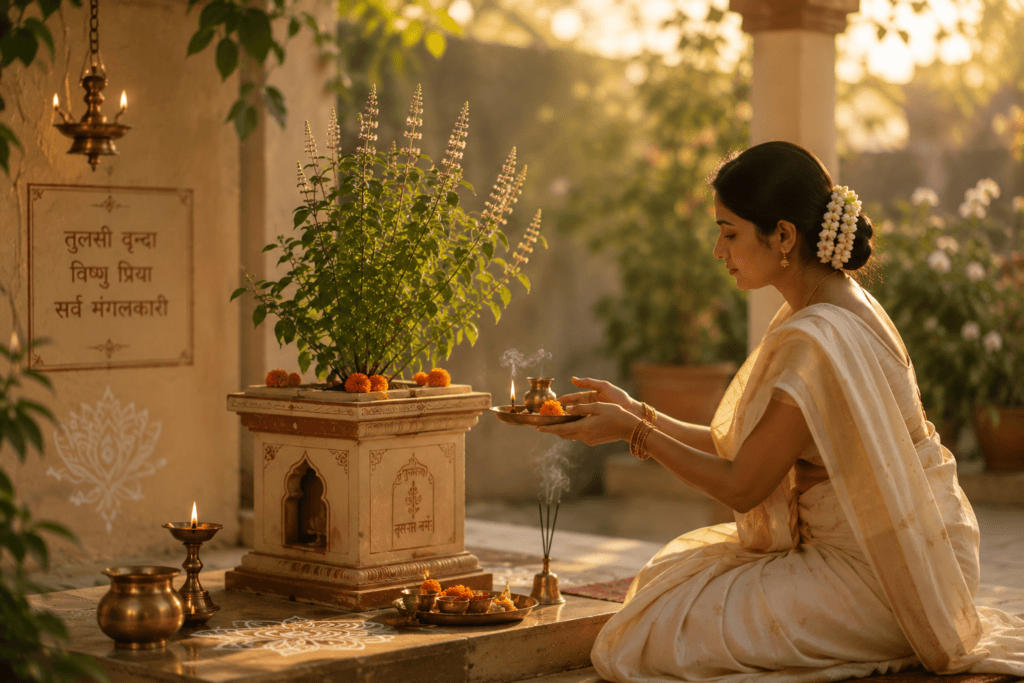
Have you ever wondered why elders insist on offering water to Tulsi after sunrise?
Many people believe it is simply to help the plant grow.
That is only one part of the truth.
Spiritually, offering water represents gratitude.
It reminds us that life itself survives because nature continuously nourishes us.
When devotees slowly pour water over Tulsi, they also slow their own minds.
For a few peaceful moments…
There is no stress.
No rushing.
No distraction.
Only silence.
Prayer.
And gratitude.
A ritual that lasts just a few minutes quietly transforms the entire day.
Sometimes the smallest habits create the biggest changes.
8. Why Tulsi Leaves Are Not Plucked Every Day
One of the most common questions people ask is this.
Why are Tulsi leaves not plucked after sunset?
Why are they traditionally avoided on certain sacred days like Dwadashi?
Many people simply follow the rule.
Very few understand its purpose.
Ancient traditions teach respect.
Tulsi is treated as a living goddess.
Instead of taking from her whenever convenient, devotees learn patience and discipline.
This practice also encourages mindful living.
Rather than acting impulsively, every action is performed with awareness.
Whether viewed spiritually or culturally, the message remains beautiful.
Respect nature.
Do not take more than necessary.
Every sacred tradition quietly teaches responsibility.
9. Tulsi Protects More Than Just the Home
For centuries, devotees have believed that Tulsi protects the household from negative influences.
Some understand this spiritually.
Others understand it emotionally.
Think about what happens in a home with daily Tulsi worship.
People begin their day with prayer.
Children witness discipline.
Families gather near the same sacred space.
Positive conversations naturally increase.
The atmosphere becomes calmer.
Whether one believes in spiritual energy or not…
Good habits always create positive environments.
Perhaps the greatest protection Tulsi offers is not against external negativity.
Perhaps she protects families from losing their connection with faith.
10. Tulsi Teaches That Greatness Can Be Simple
Tulsi is not the tallest tree.
She does not produce luxurious flowers.
She does not attract attention through beauty alone.
Yet she receives extraordinary respect.
Why?
Because greatness is never measured by appearance.
It is measured by purpose.
Today’s society often celebrates glamour.
Ancient wisdom celebrates character.
Tulsi reminds us that quiet service is often greater than loud recognition.
The people who transform lives rarely seek applause.
Like Tulsi…
They simply continue spreading goodness wherever they are planted.
This lesson may be one of the most valuable in today’s world.
Tulsi Worship Significance: The Greatest Revelation Is Still Ahead
So far, we have uncovered remarkable truths.
Tulsi Vivah celebrates divine devotion.
Offering water cultivates gratitude.
Sacred traditions teach mindfulness.
Daily worship strengthens family values.
And simplicity often carries the greatest spiritual power.
Yet one final mystery remains.
Why do ancient scriptures describe Tulsi as a bridge between the devotee and Lord Vishnu?
Why is Tulsi present in the final rites of life?
What is the deeper connection between Tulsi, salvation, and eternal peace?
And most importantly…
How can these ancient teachings help modern people live happier, calmer, and more meaningful lives?Tulsi Spiritual Importance: The Final Truth Behind Hinduism’s Most Sacred Plant
Every sacred tradition survives for one reason.
Because it carries timeless wisdom.
Tulsi has stood in the courtyards of Hindu homes for thousands of years.
Empires have risen and fallen.
Generations have changed.
Technology has transformed the world.
Yet one simple ritual continues.
Every morning…
Someone folds their hands before Tulsi.
Every evening…
A small diya glows beside her leaves.
This tradition has never been sustained by habit alone.
It has survived because people have experienced the peace it brings.
Now it’s time to uncover the final and deepest reasons why Tulsi continues to be worshipped across generations.
Tulsi Spiritual Importance: The Divine Connection Between Devotees and Lord Vishnu
Ancient scriptures repeatedly describe Tulsi as the most beloved of Lord Vishnu.
This is why almost every Vishnu Puja includes Tulsi leaves.
Without Tulsi, many sacred offerings are considered incomplete.
But why?
Because Tulsi symbolizes complete surrender.
She reminds devotees that the Divine is pleased not by expensive offerings…
But by a pure heart.
A single Tulsi leaf offered with genuine devotion carries immense spiritual value.
This beautiful teaching changes the way we understand worship.
The greatest offering has never been wealth.
It has always been sincerity.
11. Tulsi Reminds Us That Faith Begins at Home
People often travel long distances searching for peace.
Pilgrimages.
Temples.
Ashrams.
Holy rivers.
These journeys are deeply meaningful.
But Tulsi quietly teaches another truth.
The first temple is your own home.
When a family gathers every morning for a simple prayer…
When children learn gratitude from their elders…
When evenings begin with the light of a diya…
Spirituality naturally becomes part of everyday life.
Faith is no longer limited to festivals.
It becomes a way of living.
Perhaps this is why our ancestors placed Tulsi in the center of the house.
Not only to worship her…
But to keep devotion at the center of family life.
Why Tulsi Is Present During Life’s Final Journey
One of the most touching traditions in Sanatan Dharma is the use of Tulsi during the final rites of a devotee.
Many people have seen this tradition.
Very few understand its meaning.
According to Hindu scriptures, Tulsi is associated with purity and Lord Vishnu’s divine grace.
Her leaves are placed with reverence during the final moments of life and in funeral rituals as a sacred symbol of devotion and remembrance.
The belief is not about fear.
It is about hope.
Hope that a life lived with faith remains connected to the Divine even at its final moment.
This tradition reminds us of an important truth.
Our actions…
Our devotion…
And our character…
Stay with us far longer than our possessions ever will.
Tulsi Inspires Respect for Every Living Being
One extraordinary lesson often goes unnoticed.
Tulsi teaches compassion.
Think about it.
Every day, millions of people carefully water her.
Protect her from harsh weather.
Light a diya near her.
Offer prayers with folded hands.
This daily practice quietly builds respect for life itself.
A person who learns to care for one small plant often develops greater kindness toward animals, nature, and fellow human beings.
Perhaps that was always the deeper purpose.
Spirituality begins with compassion.
And compassion begins with small acts performed consistently.
Ancient Wisdom Meets Modern Science
For centuries, sages praised Tulsi as a priceless gift of nature.
Today, modern science continues exploring many of the qualities long described in Ayurveda.
Researchers have studied Tulsi for its natural compounds and its traditional role in supporting overall well-being.
While science and spirituality often appear to follow different paths…
Tulsi beautifully brings them together.
One teaches through observation.
The other through experience.
Together, they remind us that ancient traditions often carried practical wisdom alongside spiritual meaning.
This harmony is one reason Tulsi continues to remain relevant in today’s world.
The Greatest Lesson Tulsi Teaches Every Generation
If someone asked you to describe Tulsi in one word…
What would you choose?
Purity?
Faith?
Healing?
Compassion?
Devotion?
The truth is…
Tulsi represents all of them.
She teaches us that greatness doesn’t require fame.
Holiness doesn’t require wealth.
And spirituality doesn’t require complicated rituals.
A simple prayer.
A grateful heart.
A compassionate action.
A disciplined life.
These ordinary habits slowly create an extraordinary character.
That is the silent miracle Tulsi performs every single day.
Tulsi Spiritual Importance: Bringing Her Teachings Into Daily Life
Learning about Tulsi is inspiring.
Living her values is transformational.
You don’t need to become a scholar.
You don’t need to perform elaborate rituals every day.
You simply need to embrace the qualities Tulsi represents.
Begin your day with gratitude.
Respect nature.
Speak with kindness.
Remain humble during success.
Stay patient during difficulties.
Serve others without expecting rewards.
Protect your family with love rather than anger.
When these values become part of daily life…
Tulsi is no longer just growing in your courtyard.
She begins growing within your heart.
Final Thoughts: Why Tulsi Will Always Remain Sacred
People often ask,
“Why has Tulsi remained so important for thousands of years?”
The answer is surprisingly simple.
Because Tulsi never teaches through words.
She teaches through presence.
She stands silently through every season.
She gives without asking.
She heals without expecting recognition.
She reminds us to remain rooted while continuing to grow.
Perhaps this is why generations before us treated Tulsi as a member of the family rather than merely a plant.
She became a daily reminder that devotion begins with small actions.
That purity begins with honest intentions.
And that the greatest blessings often arrive in the simplest forms.
The next time you see a Tulsi plant…
Pause for a moment.
Look beyond the leaves.
Look beyond the rituals.
Because standing before you is not just a sacred plant.
It is one of Sanatan Dharma’s greatest teachers—quietly inspiring millions of hearts, one prayer at a time.
Jai Tulsi Mata. Jai Shri Hari.