Flowers Offered to Gods are among the most beautiful and familiar traditions in Hindu worship.
Walk into a temple…
You will see marigolds.
Lotus flowers.
Jasmine.
Bilva leaves.
Rose petals.
Sometimes an entire altar is covered with flowers.
But have you ever wondered…
Why flowers?
Why not simply offer food?
Why are certain flowers considered especially sacred?
Why is a lotus associated with Goddess Lakshmi?
Why are Bilva leaves offered to Lord Shiva?
And why do devotees gently place flowers before a deity instead of simply keeping them nearby?
There is a much deeper story behind this simple ritual.
Flowers represent beauty.
But their symbolism goes far beyond beauty.
They represent purity, devotion, surrender, gratitude, impermanence, and the offering of one’s inner self to the Divine.
What looks like a small ritual…
Can carry an extraordinary spiritual message.
And once you understand it, the next time you place a flower before a deity, you may look at that simple act completely differently.
Let’s uncover the first secrets.
Flowers Offered to Gods: Why Did This Tradition Begin?
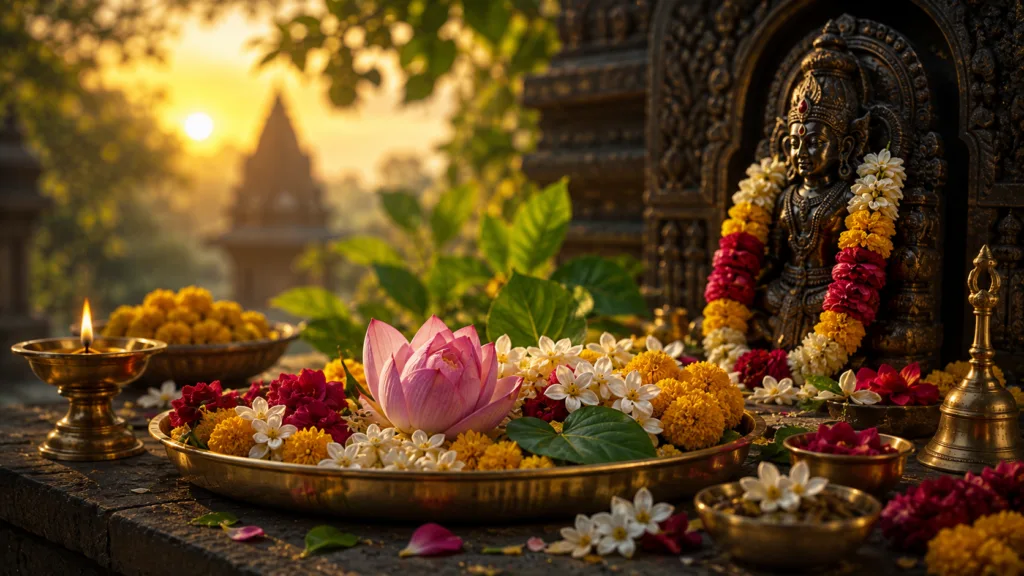
Flowers have been part of Hindu worship for centuries.
Ancient Hindu traditions frequently use flowers, leaves, fruits, water, incense, lamps, and other natural offerings during Puja.
The reason is beautifully simple.
Nature itself is considered a manifestation of divine creation.
When a devotee offers something beautiful from nature…
They symbolically return a part of that creation to its source.
A flower grows from the earth.
It receives water.
It absorbs sunlight.
It blooms at the right time.
And eventually…
It withers.
That entire journey mirrors human life.
Birth.
Growth.
Beauty.
Change.
And finally…
Transformation.
The flower therefore becomes more than an object of decoration.
It becomes a quiet reminder of life itself.
Flowers Offered to Gods: The First Sacred Meaning Is Purity
A flower begins as a tiny bud.
Slowly, it opens.
Its petals unfold.
Its fragrance spreads.
This natural process has long been associated with purity and spiritual awakening.
The flower does not struggle to prove that it is beautiful.
It simply blooms.
That becomes an important lesson for the devotee.
Spiritual growth is not always about becoming someone completely different.
Sometimes…
It is about allowing the qualities already within us to unfold.
Kindness.
Compassion.
Patience.
Gratitude.
Wisdom.
Just as a flower opens naturally…
The human heart can gradually open through devotion and self-awareness.
This is one reason flowers feel so appropriate in a sacred space.
They represent the possibility of becoming more pure in thought and intention.
The Second Sacred Meaning: Flowers Represent Devotion
Imagine entering a temple with nothing expensive.
No gold.
No elaborate gift.
No grand offering.
Just a small flower in your hand.
Does it matter?
In devotional traditions, the sincerity behind an offering matters deeply.
The flower becomes a physical expression of an invisible emotion.
“I remember You.”
“I am grateful.”
“I surrender my worries.”
“Please guide me.”
That is why even a simple flower can become meaningful.
The offering is not necessarily about its monetary value.
It is about intention.
A costly gift offered without devotion can feel empty.
A simple flower offered with a sincere heart can carry profound meaning for the devotee.
This transforms the act of offering into a personal conversation with the Divine.
Why Does a Flower Feel Different From an Ordinary Object?
Think about a stone.
It may remain unchanged for years.
A flower does not.
It blooms.
It releases fragrance.
It attracts life.
And then it slowly fades.
Its beauty is temporary.
That temporary beauty is precisely what makes it meaningful.
When devotees offer flowers, they are offering something beautiful while knowing it will not last forever.
This creates an important spiritual reminder:
Everything in the material world is temporary.
Our possessions change.
Our circumstances change.
Our bodies change.
Relationships evolve.
Seasons change.
Even happiness comes and goes.
The flower quietly teaches us to appreciate beauty without trying to possess it forever.
Flowers Offered to Gods: The Third Sacred Meaning Is Surrender
There is another beautiful idea hidden within the ritual.
When a devotee places a flower before a deity…
They are symbolically placing something in the hands of the Divine.
That can represent surrender.
Not surrender as weakness.
Surrender as acceptance.
We work hard.
We make plans.
We set goals.
We try to control outcomes.
But life often reminds us that not everything is within our control.
At some point, we have to say:
“I have done my part. Now I place the result before the Divine.”
The flower becomes a symbol of that thought.
It is placed gently.
Without force.
Without expectation.
With faith.
The Fourth Sacred Meaning: A Flower Represents the Human Heart
This is one of the most poetic interpretations of the tradition.
A closed bud resembles a heart that is still guarded.
It protects itself.
It remains tightly folded.
But when it receives the right conditions…
It opens.
The spiritual journey can be similar.
A person may begin life with fear, insecurity, anger, or attachment.
But through knowledge, compassion, prayer, and experience…
The heart gradually opens.
The flower therefore becomes a metaphor for inner transformation.
A devotee may silently pray:
“May my heart bloom like this flower.”
May it become softer.
May it become more compassionate.
May it become more generous.
May it become worthy of divine grace.
Why Are Different Flowers Offered to Different Deities?
Now the story becomes even more fascinating.
If flowers simply represented beauty…
Why would different deities have different floral associations?
Why is the lotus so closely connected with Lakshmi?
Why are certain flowers traditionally associated with Shiva?
Why do devotees use particular flowers during specific festivals?
Because Hindu worship contains layers of symbolism.
Different flowers have different colors, fragrances, shapes, cultural associations, and scriptural traditions.
The lotus, for example, is strongly associated with purity, beauty, abundance, and spiritual awakening.
Marigolds are widely used in temple and festival decoration.
Jasmine is valued for its fragrance and delicate appearance.
Different regional and devotional traditions may also follow their own customs.
So the flower itself can become part of the language of worship.
The Lotus: Why Is It So Spiritually Powerful?
The lotus may be one of the most recognizable sacred flowers in Hindu tradition.
It grows in muddy water…
Yet rises above the surface with remarkable beauty.
That creates a powerful metaphor.
The world may contain difficulties.
Life may be complicated.
People may experience stress, temptation, and uncertainty.
Yet…
A person can still rise above negativity.
The lotus therefore represents spiritual purity and transcendence in many Hindu traditions.
It teaches:
Be in the world…
But don’t let the world completely control your inner nature.
That is an extraordinary lesson hidden inside one flower.
The Fifth Sacred Meaning: Flowers Represent Beauty Without Ego
A flower is beautiful.
But it does not know that it is beautiful.
It does not demand praise.
It does not compete with another flower.
It simply exists.
Human beings can learn something from this.
We often want recognition.
We want appreciation.
We want others to notice our achievements.
But true beauty does not always need an announcement.
The flower teaches quiet excellence.
Do good.
Create beauty.
Help others.
And don’t always demand recognition in return.
That is why flowers fit so naturally into devotional traditions.
They symbolize beauty without arrogance.
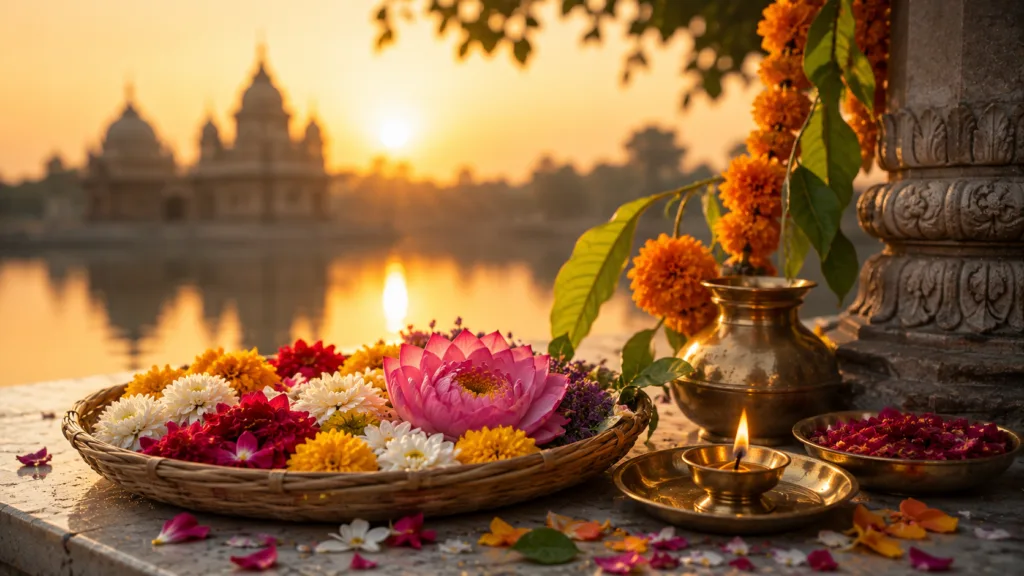
Flowers and the Five Senses
There is another fascinating dimension to flower offerings.
Flowers engage multiple senses.
We see their colors.
We smell their fragrance.
We feel their texture.
We sometimes hear them rustle as they are moved.
And during worship, they become part of a larger sensory experience involving lamps, incense, bells, chants, and sacred sounds.
This creates an immersive environment.
The devotee isn’t simply thinking about prayer.
The entire environment encourages attention.
The mind becomes more present.
This is one reason traditional Puja involves multiple offerings rather than only one object.
Each element contributes to the sacred atmosphere.
The Sixth Sacred Meaning: Flowers Symbolize Gratitude
Imagine receiving something beautiful from someone.
What do you naturally want to do?
Give something in return.
Gratitude works similarly.
A devotee looks at life…
Family.
Health.
Food.
Nature.
Opportunities.
Relationships.
And says:
“Thank you.”
The flower becomes a physical symbol of that gratitude.
It doesn’t have to represent a request.
It can simply represent appreciation.
This changes the emotional nature of worship.
Instead of always asking:
“Give me more.”
The devotee begins saying:
“Thank you for what I already have.”
That shift can be spiritually powerful.
Why Flowers Are Placed Gently Before the Deity
Watch a traditional Puja closely.
The flower is usually not thrown.
It is placed respectfully.
Sometimes it is offered with both hands.
Sometimes the devotee bows afterward.
This physical action expresses humility.
The body participates in the prayer.
The hands offer.
The head bows.
The heart remembers.
The mind focuses.
The entire act becomes a gesture of respect.
Even a few seconds can become meaningful when performed consciously.
The Seventh Meaning Is About Impermanence
This may be the most profound lesson so far.
A flower can look perfect in the morning.
By evening…
Its petals may begin to change.
The next day…
Its freshness may disappear.
Yet its temporary nature does not make it meaningless.
It makes its beauty precious.
Human life is similar.
We often postpone happiness.
“I’ll enjoy it later.”
“I’ll spend time with family later.”
“I’ll say thank you later.”
“I’ll visit them later.”
But the flower quietly reminds us:
Later is never guaranteed.
Appreciate what exists today.
Express love today.
Practice gratitude today.
Do good today.
Because the present moment is the only moment we actually possess.
A Flower Is More Than an Offering
By now, the simple act of placing a flower before a deity should look different.
It is not merely decoration.
It can represent purity.
Devotion.
Surrender.
The heart.
Beauty without ego.
Gratitude.
Impermanence.
And we have only uncovered the beginning.
Because there are still deeper questions.
Why are some flowers traditionally avoided in certain forms of worship?
Why are Bilva leaves especially important in Shiva Puja?
Why does Goddess Lakshmi have such a strong connection with the lotus?
Does the color of a flower carry symbolic meaning?
And what does it mean when a flower is offered with a specific mantra?
The tradition of Flowers Offered to Gods becomes even more fascinating when we look at the flowers themselves.
In Part 1, we discovered that a flower can represent purity, devotion, surrender, gratitude, beauty without ego, and the temporary nature of life.
But there is another layer hidden within Hindu worship.
Not every flower is used in exactly the same way.
Some are closely associated with particular deities.
Some carry special symbolism.
Some are connected with ancient stories.
And some are chosen simply because their fragrance and beauty create a sacred atmosphere.
So why does a lotus feel different from a marigold?
Why are Bilva leaves so important in Shiva worship?
Why is a red flower often associated with certain forms of Devi?
And what does the color of a flower actually communicate?
Let’s continue uncovering the mystery.
Flowers Offered to Gods: Why the Lotus Holds a Special Place
The lotus is one of the most powerful symbols in Hindu spirituality.
It appears in temple art.
Sacred scriptures.
Sculptures.
Paintings.
And devotional rituals.
Its symbolism comes from something remarkable.
The lotus grows in muddy water.
Yet when it rises above the surface…
Its petals appear remarkably clean and beautiful.
This creates a powerful spiritual metaphor.
Life may surround us with difficulties.
There may be stress.
Competition.
Disappointment.
Temptation.
But a person can still choose to remain inwardly pure.
The lotus therefore reminds devotees:
Your surroundings do not have to determine your inner nature.
You can rise above them.
Why Is the Lotus Associated With Goddess Lakshmi?
Goddess Lakshmi is traditionally associated with prosperity, abundance, beauty, fortune, and auspiciousness.
The lotus naturally complements these qualities.
It represents beauty that rises above difficult surroundings.
It also symbolizes purity and spiritual abundance.
This is why images of Goddess Lakshmi frequently depict her standing or seated on a lotus.
The symbolism is not merely decorative.
It communicates a message.
True prosperity should not only make life richer…
It should also make the heart more generous.
Wealth without wisdom can create attachment.
Beauty without humility can create ego.
Success without gratitude can create emptiness.
The lotus quietly represents prosperity accompanied by purity.
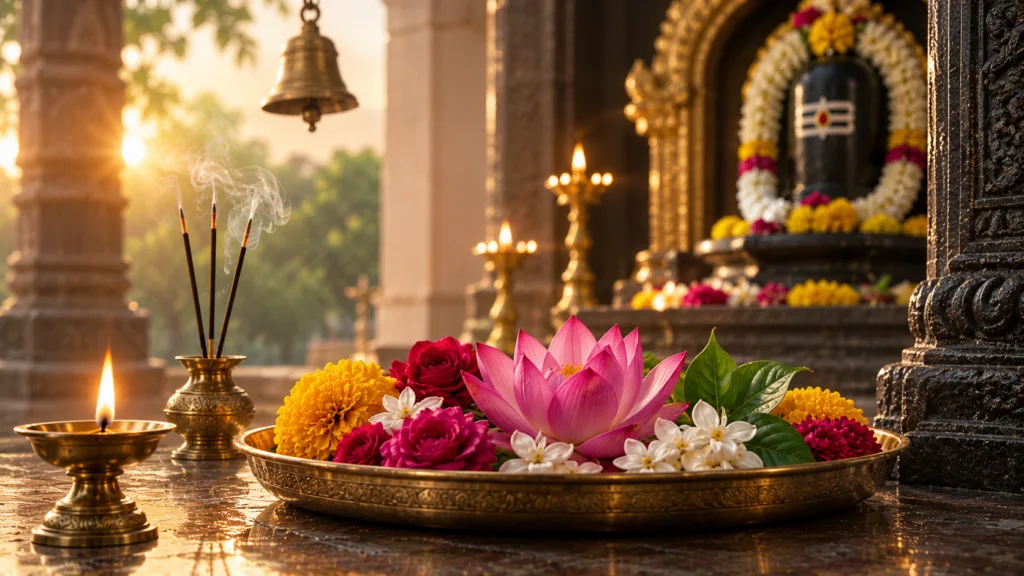
The Eighth Sacred Meaning: Flowers Can Represent Divine Qualities
A fascinating way to understand Puja is to see each offering as a reminder.
The devotee isn’t simply giving something to God.
They are also asking themselves to develop the quality represented by that offering.
A lotus may remind us of purity.
A fragrant flower may remind us to spread kindness.
A fresh flower may remind us to keep our intentions sincere.
A beautiful flower may remind us to create beauty through our actions.
In this way…
The offering becomes a spiritual mirror.
The question changes from:
“What am I giving God?”
to:
“What quality am I trying to cultivate within myself?”
That is a much deeper form of worship.
Why Are Marigolds So Common in Hindu Worship?
Walk into a temple during a festival…
And chances are you’ll see marigolds everywhere.
Garlands.
Torans.
Puja thalis.
Temple decorations.
Home entrances.
Marigolds are especially popular because they are vibrant, long-lasting, and traditionally associated with auspicious celebrations.
Their bright orange and yellow shades create a sense of warmth and festivity.
They are used extensively across many regions of India.
But there is also something symbolic about their appearance.
Their strong color immediately attracts attention.
During worship, they help transform an ordinary space into a festive and sacred environment.
The flower becomes part of the visual language of celebration.
Why Are Fragrant Flowers Used During Puja?
Jasmine, rose, champa, mogra, and other fragrant flowers are frequently used in devotional settings.
Why?
Fragrance creates an immediate sensory experience.
One moment you enter a temple…
And suddenly you notice the scent of flowers mixed with incense.
The atmosphere feels different.
Fragrance can also become a reminder of presence.
Just as a flower spreads fragrance without demanding anything in return…
Devotees may aspire to let their actions spread kindness and positivity.
A beautiful thought:
Let your character become like fragrance.
It should reach others naturally.
Without announcement.
Without ego.
Without expectation.
Flowers Offered to Gods: Why Color Can Matter
Color has always played an important role in Hindu symbolism.
Different colors can evoke different emotions and associations.
Red may represent energy, passion, strength, or divine feminine power.
White is commonly associated with purity, peace, and clarity.
Yellow can represent auspiciousness, knowledge, and spiritual warmth.
Blue is often associated with vastness, depth, and the Divine.
However, floral customs can vary significantly by deity, region, temple tradition, and scripture.
So color symbolism should not be treated as one universal rule.
The deeper lesson is that worship engages both the mind and the senses.
Color helps create an emotional atmosphere.
And that atmosphere can help devotees focus their attention.
Why Are Bilva Leaves Offered to Lord Shiva?
Now we come to one of the most famous offerings associated with Lord Shiva.
The Bilva leaf, also known as Bel Patra.
Unlike a traditional flower, it is a leaf.
Yet it holds an extremely important place in Shiva worship.
The Bilva leaf is traditionally offered to the Shivling.
Its three leaflets are often connected symbolically with different triads in Hindu thought, including associations with Shiva’s trident and the three qualities of nature.
The exact interpretation can vary across traditions.
But the offering carries a powerful message.
Simplicity can be sacred.
You don’t always need something extravagant to express devotion.
A leaf offered sincerely can become a meaningful act of worship.
The Story Behind Sacred Offerings Is Often More Important Than Their Price
Modern life teaches us to measure value through cost.
The more expensive something is…
The more valuable we assume it must be.
Puja offers a different perspective.
A simple flower.
A few leaves.
A small diya.
A little water.
These ordinary things can become sacred through intention.
This teaches an important lesson.
Devotion is not a competition.
You don’t need the most expensive offering.
You need sincerity.
The value lies in the heart behind the action.
The Ninth Sacred Meaning: Flowers Represent Selfless Offering
There is something beautiful about a flower.
It gives fragrance.
It gives beauty.
It attracts life.
And eventually…
It gives itself completely.
The devotee can see this as a metaphor for selfless action.
Do good without constantly asking:
“What will I get in return?”
Help someone.
Share knowledge.
Support your family.
Feed someone hungry.
Speak kindly.
Offer your time.
The flower becomes a reminder that giving itself can be meaningful.
This is one of the deepest lessons hidden in a seemingly simple ritual.
Why Are Flowers Offered With Mantras?
A flower can be offered silently.
But during formal Puja, it is often accompanied by a mantra or prayer.
Why combine the two?
Because the physical offering and the spoken intention work together.
The flower represents the offering.
The mantra expresses the intention.
The hands perform the action.
The mind focuses.
The heart connects.
This creates a complete devotional experience.
Instead of simply placing a flower somewhere…
The devotee consciously participates in the moment.
What Happens When Worship Becomes Mechanical?
There is an important lesson here.
A person can perform every ritual perfectly…
And still remain distracted.
Flowers may be arranged beautifully.
The Puja thali may look perfect.
The altar may be decorated magnificently.
But if the mind is somewhere else…
Something is missing.
The purpose of ritual is not only external beauty.
It is internal attention.
Even a single flower offered with complete awareness can become more meaningful than a large decoration performed mechanically.
This is why intention matters so much.
Flowers and the Idea of Ahimsa
Flowers are living parts of nature.
Their use in worship can also remind devotees of their relationship with the natural world.
Plants provide food.
Medicine.
Oxygen.
Beauty.
Shelter.
And countless ecological benefits.
The tradition of using natural offerings creates an opportunity to remember our dependence on nature.
This can inspire a more respectful attitude toward the environment.
Worshipping nature while destroying it would create a contradiction.
The deeper spiritual lesson is therefore not simply:
“Take flowers from nature.”
It can also be:
“Respect the nature from which your offerings come.”
Why Fresh Flowers Are Traditionally Preferred
Fresh flowers are generally preferred in many Puja traditions.
Why?
Because freshness represents purity and sincerity.
A fresh flower is at its best.
It is vibrant.
Fragrant.
Alive.
Offering something fresh can symbolize giving one’s best.
Not what is left over.
Not what is unwanted.
But something chosen with care.
This creates another beautiful lesson.
When we give our time, attention, or service to others…
Are we giving our best?
Or merely what remains after everything else?
The flower quietly asks that question.
Why Some Flowers Are Traditionally Avoided
This is where Hindu traditions become particularly diverse.
Different scriptures, communities, temples, and regional traditions prescribe different flowers for different deities.
Some flowers may be preferred.
Some may be avoided.
And the reasons can involve mythology, ritual rules, local customs, or scriptural traditions.
Therefore, there is no single universal list that applies identically to every form of Hindu worship.
This is why it is wise to follow the tradition of the particular deity and Puja being performed.
A knowledgeable Pandit can guide devotees about the appropriate offerings.
The goal isn’t simply to follow a random internet list.
It is to understand the tradition correctly.
A Flower Can Become a Personal Prayer
Here’s perhaps the most beautiful way to look at the entire tradition.
You don’t always need complicated words.
Sometimes…
A flower can say:
Thank you.
Please guide me.
Give my family strength.
Help me remain peaceful.
Give me wisdom.
Help me let go.
The flower becomes a silent language.
The devotee may not say everything aloud.
But the heart knows.
And that is what makes the ritual deeply personal.
What Do You Offer When You Have Nothing?
Imagine someone entering a temple without any Puja Samagri.
No fruits.
No sweets.
No flowers.
Nothing.
Can they still pray?
Of course.
Devotion is not limited by possessions.
A prayer can begin with folded hands.
A sincere thought.
A moment of silence.
A heart filled with gratitude.
The flower is a symbol…
Not a requirement for the Divine to hear a devotee.
This distinction is important.
Ritual gives structure to devotion.
But devotion itself is deeper than objects.
The Final Chapter Holds an Even Deeper Secret
We’ve now uncovered the lotus…
Marigold…
Fragrance…
Colors…
Bilva leaves…
Mantras…
Freshness…
Selfless offering…
And the importance of intention.
But one question remains.
What is the most important flower you can offer to God?
Is it a lotus?
A rose?
A marigold?
Or is there another answer hidden in ancient spiritual wisdom?
What if the most meaningful offering isn’t something growing in a garden at all?
What if the flower God truly wants is something that must first bloom inside you?
In Part 3, we’ll explore the deepest spiritual symbolism of flower offerings and discover how qualities such as compassion, truth, patience, humility, and devotion can become the ultimate offering.
Because perhaps…
The most beautiful flower is not the one you place before God.
It is the one you allow to bloom within your heart.
Flowers Offered to Gods may look like a simple part of Puja, but after exploring their symbolism, one truth becomes increasingly clear.
The flower is not merely an object placed before a deity.
It can represent something much deeper.
A feeling.
A quality.
A prayer.
A surrender.
Even a part of ourselves.
But now comes the most beautiful question.
What is the ultimate flower that a devotee can offer?
The answer may have nothing to do with a garden.
It may be something that has to bloom within us.
Flowers Offered to Gods: The Heart Can Become the Greatest Offering
Imagine placing a beautiful flower before a deity.
It looks perfect.
Fresh petals.
Beautiful color.
Wonderful fragrance.
But imagine doing it while carrying anger, jealousy, hatred, or dishonesty in the heart.
What is missing?
The outer offering is beautiful.
But the inner offering has not yet happened.
This is why the deeper purpose of Puja is transformation.
The flower becomes a reminder:
Let your thoughts become beautiful too.
Let your words carry kindness.
Let your actions carry honesty.
Let your heart carry compassion.
Then the physical flower becomes a reflection of an inner offering.
That is where ritual becomes spiritual.
The Flower of Truth
Truth is one of the most powerful qualities a person can cultivate.
Yet truth is not always easy.
Sometimes telling the truth can be uncomfortable.
It can require courage.
It may force us to admit mistakes.
It may require us to accept that we were wrong.
But spiritual traditions place immense value on sincerity.
So imagine offering a flower while silently making a promise:
“May my words become truthful.”
The flower then becomes a symbol of integrity.
Not just something beautiful to look at…
But something that reminds us to live beautifully.
The Flower of Compassion
A flower does not ask who deserves its fragrance.
It simply spreads it.
That makes it a beautiful metaphor for compassion.
We often divide people.
Those we like.
Those we dislike.
Those who help us.
Those who disagree with us.
But compassion asks us to look beyond these categories.
Someone may be struggling silently.
Someone may need encouragement.
Someone may simply need to be heard.
The next time you offer a flower during Puja, you can let it remind you:
Be a source of kindness wherever you go.
The Flower of Patience
A flower cannot be forced to bloom overnight.
You can water it.
Give it sunlight.
Protect it.
Care for it.
But you cannot command it:
“Bloom now.”
Nature follows its own timing.
Human life is similar.
We want immediate results.
Instant success.
Quick answers.
Fast growth.
But some things need time.
A relationship needs time.
A career needs time.
Wisdom needs time.
Healing needs time.
The flower teaches patience without saying a single word.
Perhaps that is why it feels so natural in a sacred space.
The Flower of Humility
A flower can be beautiful without becoming arrogant.
It never compares itself with another flower.
It doesn’t ask:
“Am I more beautiful than the flower next to me?”
Humans often do.
We compare salaries.
Homes.
Businesses.
Appearance.
Achievements.
Social status.
And comparison can quietly steal peace.
The flower offers another lesson:
Grow beautifully without needing to prove that you are better than someone else.
That is humility.
And humility is one of the most powerful forms of inner strength.
The Flower of Forgiveness
This is perhaps one of the hardest qualities to cultivate.
Someone hurts us.
We remember.
Years may pass…
Yet the memory remains.
Forgiveness doesn’t mean pretending that nothing happened.
It doesn’t mean accepting harmful behavior.
It means refusing to let anger control the rest of your life.
The flower can become a symbol of releasing bitterness.
When a devotee places an offering before the Divine, they may also silently release something they have been carrying.
A grudge.
A painful memory.
A disappointment.
A regret.
The offering becomes a moment of emotional surrender.
Flowers Offered to Gods: Why the Ritual Can Become a Daily Reminder
A beautiful spiritual practice does not end when the Puja ends.
Its lesson should continue into everyday life.
You offer a flower in the morning…
Then practice patience at work.
You offer a flower before the deity…
Then speak kindly to your family.
You offer flowers during a festival…
Then help someone who needs support.
You offer a lotus…
Then try to remain pure despite difficult surroundings.
This is how ritual becomes meaningful.
The Puja becomes the beginning.
Your actions become the continuation.
The Difference Between Ritual and Devotion
Ritual gives structure.
Devotion gives meaning.
You can have a beautifully decorated Puja space.
You can arrange flowers perfectly.
You can light dozens of lamps.
But if the heart is absent…
The experience can become mechanical.
On the other hand, someone sitting quietly with a single flower and a sincere heart may experience profound devotion.
This does not mean rituals are unimportant.
They are deeply meaningful within Hindu traditions.
It means the external ritual and internal intention should ideally support each other.
The flower is outside.
The devotion is inside.
Together…
They create the complete offering.
Why Children Can Learn Spirituality Through Flowers
Children often understand symbolism through simple things.
Instead of giving them complicated philosophical explanations…
Give them a flower.
Ask:
“What happens to a flower after a few days?”
It withers.
Then ask:
“So why do we still offer it?”
Because its beauty is meaningful even though it is temporary.
This simple conversation can introduce children to profound ideas.
Everything changes.
Nothing should be taken for granted.
Beauty should be appreciated.
Nature should be respected.
And gratitude should be practiced.
A small flower can therefore become the beginning of a much larger spiritual conversation.
Flowers and Respect for Nature
There is another lesson worth remembering.
Flowers come from nature.
They need soil.
Water.
Sunlight.
Pollinators.
Healthy ecosystems.
When we use flowers during worship, we can also remember the natural world that makes those offerings possible.
This can inspire mindful practices.
Avoid unnecessary wastage.
Choose locally available flowers when appropriate.
Compost natural offerings where possible.
Keep temple surroundings clean.
Avoid plastic decorations mixed with natural Puja materials.
Devotion and environmental responsibility do not have to be separate.
They can support each other.
What Happens to Flowers After Puja?
After worship, flowers may remain at the altar.
Many families respectfully place used flowers in a clean natural location or compost them according to their customs.
The important idea is respect.
A flower that has been offered should not simply become careless waste.
This can become another reminder:
Sacredness should continue even after the ritual ends.
In modern homes, thoughtful disposal of organic Puja materials can also reduce unnecessary waste.
Small habits can make spiritual practices more environmentally responsible.
The Hidden Language of Different Flowers
By now, we’ve seen that flowers can communicate without words.
A lotus can remind us of purity.
A fragrant flower can represent the spread of goodness.
A fresh flower can represent sincerity.
A bright flower can create an atmosphere of celebration.
A Bilva leaf can represent sacred associations with Lord Shiva.
But there is an important principle:
Symbolism can vary by tradition.
Different temples, regions, families, scriptures, and communities may have their own customs.
So the meaning of a particular flower should not always be treated as one universal rule.
The beauty of Hindu traditions lies partly in their diversity.
The same act of devotion can take different forms while expressing the same underlying values.
The Most Powerful Flower Is the One Within You
Now we arrive at the heart of this entire journey.
What if the flower you offer to God represents you?
Your heart.
Your intentions.
Your actions.
Your character.
The petals represent your qualities.
The fragrance represents your influence on others.
The freshness represents your sincerity.
The blooming represents your spiritual growth.
And the eventual fading reminds you that life is temporary.
Suddenly…
A simple flower becomes a mirror.
It asks:
What am I offering to the world?
Kindness?
Anger?
Peace?
Negativity?
Wisdom?
Ego?
Compassion?
That may be the most powerful question of all.
9 Powerful Sacred Meanings We Discovered
Let’s bring the entire three-part journey together.
1. Purity
The blooming flower symbolizes the possibility of inner purification and spiritual awakening.
2. Devotion
A simple flower becomes a physical expression of love, remembrance, and prayer.
3. Surrender
Offering a flower can symbolize placing our worries, expectations, and outcomes before the Divine.
4. The Human Heart
A blooming flower can represent a heart opening through wisdom, compassion, and devotion.
5. Beauty Without Ego
The flower is beautiful without demanding recognition.
6. Gratitude
Offering something beautiful can become a simple expression of thankfulness.
7. Impermanence
A flower reminds us that everything in the material world changes.
8. Selfless Giving
The flower can symbolize giving without constantly expecting something in return.
9. Inner Transformation
The ultimate offering is not only the flower in our hands…
It is the goodness we cultivate within ourselves.
Flowers Offered to Gods: The Real Purpose of the Ritual
After everything we’ve explored, the answer to the original question becomes beautifully simple.
Why are flowers offered to Gods?
Because flowers speak a language that words sometimes cannot.
They speak of beauty.
Purity.
Devotion.
Gratitude.
Surrender.
Growth.
Change.
And love.
A devotee may place one small flower before a deity.
But behind that action can be an entire prayer.
“May my heart become pure.”
“May my thoughts become beautiful.”
“May I remain humble.”
“May I learn to let go.”
“May I spread kindness.”
“May I accept life’s changes with faith.”
The flower is small.
The meaning is enormous.
Final Thoughts: Let Your Life Become the Offering
The next time you see flowers arranged before a deity…
Pause for a moment.
Look at them.
Notice their color.
Their fragrance.
Their delicate petals.
Their temporary beauty.
And remember what they can represent.
You don’t have to wait until you enter a temple to practice their lessons.
Be patient like a flower.
Be generous with your fragrance.
Rise above difficulties like the lotus.
Remain humble in your beauty.
Accept change with grace.
Give without always expecting something back.
And allow your heart to keep blooming.
Because perhaps the greatest lesson of all is this:
God does not only receive the flower placed before Him.
The devotee is invited to become the flower.
A life filled with kindness.
A heart filled with gratitude.
A mind filled with wisdom.
And actions filled with devotion.
That is when a simple ritual becomes a way of life.
And that is when…
A single flower becomes a prayer.
A prayer becomes a habit.
A habit becomes a character.
And character becomes a beautiful life.
Jai Shri Krishna. Har Har Mahadev.