Maha Mrityunjaya Mantra is one of the most revered Shiva mantras in Hindu spiritual tradition.
For centuries, devotees have chanted it during prayer, meditation, difficult phases of life, and important religious ceremonies.
But there is something fascinating about this ancient mantra.
Most people know it as a powerful prayer associated with Lord Shiva.
Very few understand why it is considered so sacred.
What does the mantra actually mean?
Why is it connected with the name Mahamrityunjaya?
Why do devotees chant it repeatedly?
Is it only a prayer for protection?
Or does it carry a much deeper message about fear, life, death, and spiritual awakening?
The answers are hidden within every word.
And once you understand them…
The mantra begins to feel completely different.
This three-part journey explores seven powerful secrets behind this ancient invocation, its spiritual symbolism, traditional significance, and the deeper wisdom that has kept it alive across generations.
But before discovering its secrets…
We need to understand where its power comes from.
Maha Mrityunjaya Mantra: Why Is Lord Shiva Called Mahamrityunjaya?
The name itself carries a profound meaning.
Maha means great.
Mrityu refers to death.
Jaya means victory or triumph.
Together, Mahamrityunjaya is traditionally understood as the great conqueror of death.
This does not simply mean that devotees believe physical death can be permanently defeated.
The deeper spiritual interpretation is much more profound.
The mantra is associated with overcoming the fear of death.
And fear can sometimes be more powerful than the event itself.
Think about how fear changes a person.
It creates anxiety.
It creates uncertainty.
It makes the mind imagine the worst.
It can prevent someone from enjoying the present moment.
The Shiva tradition teaches devotees to move beyond that fear through surrender, awareness, and devotion.
That is where the true beauty of this mantra begins.
Maha Mrityunjaya Mantra: The Ancient Verse Behind the Tradition
The mantra comes from the ancient Rig Veda and is also found in the Yajurvedic tradition.
It is commonly recited as:
“Om Tryambakam Yajamahe
Sugandhim Pushtivardhanam
Urvarukamiva Bandhanan
Mrityor Mukshiya Maamritat.”
Every line contains layers of symbolism.
It invokes Tryambaka, the three-eyed form of Lord Shiva.
It describes the Divine as fragrant and nourishing.
It compares liberation to a ripe fruit naturally separating from its binding vine.
And it expresses a profound prayer for freedom from death and attachment to mortality.
But there is a beautiful detail hidden inside this imagery.
The mantra doesn’t simply say:
“Remove death.”
It asks for liberation from the bondage of mortality while seeking the state of immortality.
This distinction changes the entire meaning.
Secret #1: The Mantra Is About More Than Physical Protection
One of the biggest misunderstandings is that this is simply a mantra for avoiding physical death.
Traditional spiritual interpretations go much deeper.
Human beings experience many forms of “death.”
The death of hope.
The death of confidence.
The death of relationships.
The death of purpose.
The end of one stage of life.
The beginning of another.
In this sense, the mantra becomes a prayer for inner strength.
It reminds devotees that endings are not always destruction.
Sometimes…
An ending is the doorway to transformation.
A difficult chapter closes.
A new one begins.
This is why the mantra has remained meaningful during times of uncertainty.
It gives the mind something more powerful than fear.
Faith.
Secret #2: The Three-Eyed Shiva Represents a Deeper Vision
One of the most fascinating words in the mantra is Tryambakam.
It refers to the three-eyed form of Shiva.
The third eye has extraordinary significance in Shaiva tradition.
The two ordinary eyes perceive the external world.
The third eye symbolizes deeper knowledge, insight, and spiritual awareness.
When Shiva opens the third eye in Hindu mythology, it represents the destruction of ignorance and illusion.
This gives the mantra another powerful dimension.
Perhaps devotees are not only asking for protection from external difficulties.
Perhaps they are also praying:
“May I see the truth clearly.”
Imagine having the ability to see beyond temporary problems.
A difficult situation may appear permanent.
But wisdom reveals that it will pass.
A failure may appear like the end.
But experience reveals a lesson.
A loss may feel meaningless.
But time may reveal its transformation.
This deeper vision is one of the spiritual ideas associated with Shiva’s third eye.
Why the Third Eye Matters in Modern Life
Today’s world is filled with information.
Notifications.
Opinions.
News.
Social media.
Constant comparison.
Yet more information doesn’t necessarily create more wisdom.
We can see everything…
And still fail to understand what truly matters.
The symbolism of Shiva’s third eye reminds us to look beyond appearances.
To pause.
To observe.
To question.
To understand.
This is one reason meditation and mantra chanting remain meaningful to many devotees.
They create a moment of stillness in a noisy world.
And sometimes…
Clarity appears only when the noise becomes quiet.
Secret #3: “Sugandhim” Carries a Beautiful Symbolic Meaning
Another fascinating word is Sugandhim.
It is traditionally associated with fragrance.
But why would a spiritual mantra describe Shiva through fragrance?
Because fragrance spreads without force.
A flower doesn’t announce that it is fragrant.
It simply is.
Its presence affects everything around it.
This becomes a beautiful metaphor for spiritual character.
A truly compassionate person doesn’t need to announce their goodness.
People experience it.
A wise person doesn’t need to prove wisdom.
Their actions reveal it.
A peaceful person doesn’t need to tell others they are peaceful.
Their presence communicates it.
The mantra therefore invites devotees to cultivate qualities that naturally spread positivity.
Like fragrance.
Quietly.
Naturally.
Without seeking recognition.
Secret #4: “Pushtivardhanam” Connects the Divine With Nourishment
The mantra also describes Shiva as Pushtivardhanam.
This is traditionally understood in connection with nourishment, growth, and strengthening.
But nourishment isn’t limited to the physical body.
The mind needs nourishment.
The heart needs nourishment.
The spirit needs nourishment.
What happens when the mind constantly consumes negativity?
It becomes restless.
What happens when we constantly compare ourselves with others?
Confidence begins to weaken.
What happens when we spend time with people who inspire us?
Something changes.
We become stronger.
This is why spiritual traditions place importance on what we allow into our minds.
The mantra becomes a reminder to nourish ourselves with faith, wisdom, positive thoughts, and meaningful actions.

A Mantra for Strength During Difficult Times
Life does not always follow our plans.
There are moments when everything seems uncertain.
A career may suddenly change.
A family may face difficulties.
A person may experience loss.
A new chapter may begin without warning.
During such moments, the human mind searches for stability.
The Maha Mrityunjaya tradition offers a spiritual anchor.
Devotees sit quietly.
They repeat the mantra.
They breathe.
They listen to the sacred words.
And gradually…
The mind becomes less scattered.
The problem may still exist.
But the person’s relationship with the problem can change.
Fear may become acceptance.
Confusion may become clarity.
Restlessness may become patience.
That transformation itself can be deeply meaningful.
Maha Mrityunjaya Mantra: Why Repetition Is Considered Important
Why do devotees chant a mantra repeatedly?
Why not say it once and finish the prayer?
Repetition is an important part of many mantra traditions.
When a phrase is repeated…
The mind gradually becomes focused on it.
Distractions begin to reduce.
Breathing may become more rhythmic.
Attention becomes steadier.
The mantra stops being just a sentence.
It becomes an experience.
This is one reason devotees may perform Japa, repeating the mantra a prescribed number of times according to their spiritual practice or the guidance of a Pandit or Guru.
The purpose is not simply counting repetitions.
It is developing concentration and devotion.
Secret #5: The Mantra Contains a Powerful Lesson About Attachment
One of the most beautiful images in the mantra is the comparison to a ripe cucumber or fruit separating naturally from its vine.
The imagery is subtle.
A fruit does not need to violently destroy the vine.
When it becomes ripe…
It naturally separates.
This is traditionally interpreted as a metaphor for liberation.
Human beings often cling tightly.
To possessions.
To relationships.
To status.
To memories.
To expectations.
But life constantly changes.
The spiritual lesson is not to stop loving.
It is to understand that everything in the material world is temporary.
Love deeply.
Care sincerely.
But learn to accept change.
This is one of the most profound messages hidden inside the mantra.
Why This Message Is Relevant Today
Modern life often encourages attachment.
We are told to acquire more.
Achieve more.
Own more.
Become more successful.
But very little teaches us how to let go.
Letting go doesn’t mean giving up.
It means understanding what is within our control…
And what isn’t.
You can control your effort.
You cannot control every result.
You can control your words.
You cannot control everyone’s reaction.
You can care for someone.
You cannot control their choices.
The wisdom associated with the mantra encourages this balance.
Effort without excessive attachment.
The Most Powerful Secret Is Still Ahead
We’ve already uncovered several layers.
The meaning of Mahamrityunjaya.
The symbolism of Shiva’s third eye.
The fragrance of spiritual character.
The idea of nourishment.
The importance of repetition.
And the powerful lesson of letting go.
But there is still much more.
Why is this mantra especially associated with difficult times?
What is the connection between fear and spiritual freedom?
Why do devotees traditionally include it in certain Puja ceremonies?
Can it be chanted by anyone?
What is the significance of chanting it during Rudra Abhishek and other Shiva rituals?
And perhaps the most important question…
What is the difference between chanting a mantra mechanically and chanting it with true devotion?
These answers reveal an entirely different side of this ancient prayer.
The journey into the Maha Mrityunjaya Mantra becomes even more fascinating when we look beyond its familiar words.
Why does this mantra become especially meaningful during difficult moments?
Why do devotees repeat it with such deep faith?
And why is it often included in Shiva worship and sacred ceremonies?
The answer begins with something every human being understands.
Fear.
Maha Mrityunjaya Mantra: Why Do People Turn to It During Difficult Times?
When life is comfortable, faith can feel effortless.
But when uncertainty arrives…
Everything changes.
A person may suddenly begin questioning the future.
What will happen next?
Will everything be okay?
How will I overcome this?
During such moments, people often search for something that gives them emotional and spiritual stability.
For generations, devotees have turned toward Lord Shiva through this sacred mantra.
The traditional belief is that its recitation invokes Shiva’s grace and offers spiritual protection, courage, and peace.
It becomes an anchor.
Not necessarily because the situation instantly changes…
But because the mind finds something steady to hold onto.
And sometimes…
That inner steadiness is the beginning of strength.
Secret #6: It Teaches Us to Face Fear Instead of Running From It
Think about the word Mrityu.
Death.
It is one of humanity’s oldest fears.
People avoid discussing it.
They try not to think about it.
Yet the mantra places the subject directly into prayer.
Why?
Because spiritual wisdom often begins by facing what frightens us.
The mantra does not pretend that mortality doesn’t exist.
Instead, it asks for liberation from its bondage.
This creates a profound shift.
Rather than:
“I am afraid of death.”
The spiritual attitude becomes:
“May I understand life deeply enough that fear no longer controls me.”
That is a completely different form of courage.
Maha Mrityunjaya Mantra: The Difference Between Protection and Fear
When people hear the word “protection,” they sometimes imagine that nothing bad will ever happen.
But spiritual protection can mean something deeper.
Protection from hopelessness.
Protection from negative thinking.
Protection from losing faith.
Protection from allowing fear to control decisions.
Protection from forgetting one’s inner strength.
This doesn’t mean devotees should ignore medical care, professional advice, or practical responsibilities.
Spiritual practice and practical action can exist together.
If someone is ill, prayer may provide comfort and faith.
Medical treatment remains important.
If someone is facing a difficult situation, mantra may provide emotional strength.
Practical action remains necessary.
Faith does not replace responsibility.
It strengthens the heart that carries it.
Secret #7: The Mantra Is a Prayer for Liberation, Not Just Longevity
This is one of the most important distinctions.
Many people know this mantra as a prayer for health and longevity.
That is certainly part of its devotional use.
But its deeper spiritual meaning goes beyond simply asking for more years.
The final phrase speaks of freedom from Mrityu while remaining connected with Amrita, the immortal or deathless principle.
This introduces a profound philosophical idea.
A human life is temporary.
The body changes.
Circumstances change.
Relationships change.
Even our thoughts change.
Yet spiritual traditions speak of something deeper that transcends these temporary forms.
The mantra points the mind toward that deeper reality.
So its message becomes:
Live fully.
Live consciously.
Live with devotion.
And learn to move beyond the fear of impermanence.
Why Shiva Is the Perfect Deity for This Mantra
Lord Shiva occupies a unique place in Hindu philosophy.
He is associated with both destruction and transformation.
At first, destruction sounds frightening.
But consider nature.
A seed must break open before it becomes a plant.
The old must sometimes disappear before the new can emerge.
Winter gives way to spring.
Night gives way to morning.
Shiva’s symbolism therefore reminds devotees that destruction is not always the end.
Sometimes…
It is transformation.
This makes the Mahamrityunjaya tradition especially powerful.
The devotee isn’t simply asking Shiva to prevent every ending.
They are asking for the wisdom and grace to move through change.
Why Devotees Chant It During Rudra Abhishek
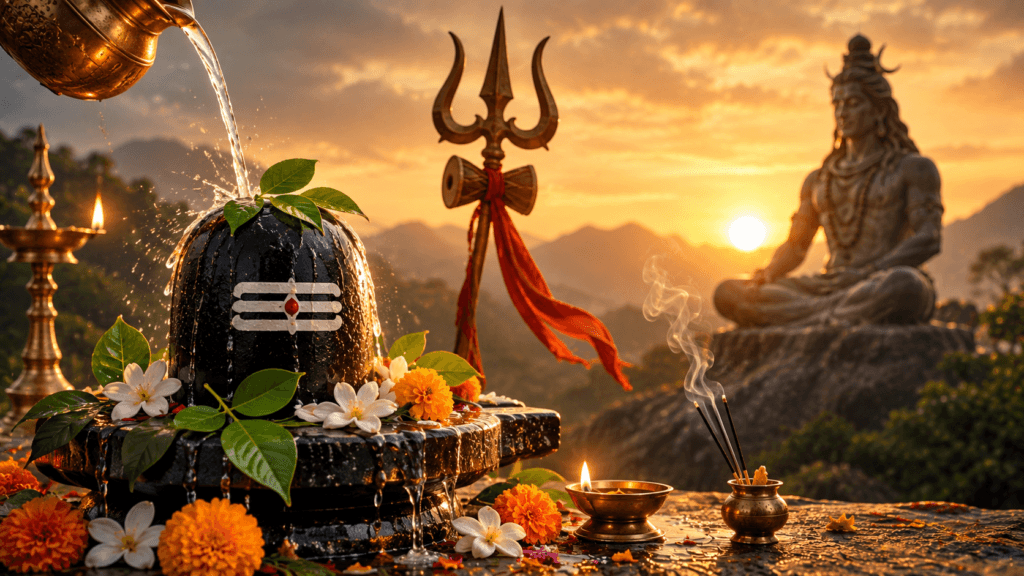
The mantra is closely associated with Shiva worship and is often recited during Rudra Abhishek and other sacred ceremonies.
Imagine the scene.
A Shivling is placed at the center.
Water flows gently over it.
Bilva leaves are offered.
Flowers surround the sacred space.
A Pandit chants Vedic mantras.
The sound of the Maha Mrityunjaya Mantra fills the atmosphere.
The ritual becomes an experience involving sound, water, devotion, and concentration.
For devotees, this combination creates a deeply spiritual environment.
The Abhishek symbolizes purification.
The mantra expresses surrender.
The offerings represent devotion.
Together, they create a sacred moment of reflection.
Maha Mrityunjaya Mantra: Why Sankalp Matters
A beautiful concept in Hindu worship is Sankalp.
It means making a conscious spiritual intention before beginning a ritual.
Instead of chanting mechanically…
The devotee knows why they are praying.
Perhaps for peace.
Perhaps for the well-being of a loved one.
Perhaps for spiritual strength.
Perhaps during an important life transition.
The intention gives the practice meaning.
Imagine two people repeating the same words.
One is distracted.
The other is completely present.
The words may be identical.
But the experience can feel entirely different.
This is why devotion and awareness matter.
A mantra is not simply sound.
For devotees, it becomes a relationship with the Divine.
Can Anyone Chant the Mantra?
This is a question frequently asked.
The answer depends on the tradition and the form of practice.
The Maha Mrityunjaya Mantra is widely used in Hindu prayer, meditation, and devotional practice.
For formal Vedic rituals or specific spiritual disciplines, many traditions recommend learning the correct pronunciation and method from a knowledgeable Pandit or Guru.
This is especially important when the mantra is being used as part of an elaborate ritual.
For personal devotional chanting, people may choose to recite it respectfully according to their family or spiritual tradition.
The most important elements are sincerity, attention, and respect.
Why Correct Pronunciation Is Traditionally Valued
Sanskrit mantras are not ordinary sentences.
They have specific sounds and pronunciations.
In Vedic traditions, pronunciation has traditionally been given great importance.
A slight change in sound can alter the way a Sanskrit word is pronounced.
This is why experienced priests learn Vedic recitation carefully.
For devotees who are unfamiliar with Sanskrit…
Listening to an authentic recitation and learning from a knowledgeable teacher can be helpful.
But the purpose should never be perfection at the cost of devotion.
The heart and the method should work together.
The Power of Repetition: Why Japa Feels Different
Have you ever repeated a word so many times that everything else around you seemed to disappear?
That is one reason mantra Japa can feel deeply immersive.
The repetition gives the mind one point of focus.
Breathing becomes more conscious.
Thoughts gradually slow down.
Attention becomes steadier.
For many devotees, the experience becomes meditative.
The outside world doesn’t necessarily disappear.
But the mind becomes less scattered.
This is especially meaningful in today’s world.
We constantly switch between tasks.
Messages.
Calls.
Emails.
Videos.
Notifications.
Mantra repetition creates the opposite experience.
One sound.
One rhythm.
One intention.
One moment.
A Sacred Practice During Life’s Transitions
The mantra can become especially meaningful during major life transitions.
Beginning a new journey.
Moving through grief.
Facing uncertainty.
Starting a spiritual practice.
Praying for the well-being of someone dear.
During these moments, people often feel that life is outside their control.
The mantra creates a moment of surrender.
It says, in essence:
I will do what I can.
I will remain devoted.
I will trust the Divine with what I cannot control.
That balance between effort and surrender is one of the most beautiful ideas in Hindu spirituality.
What the Mantra Can Teach Modern Families
The wisdom isn’t limited to temples.
Families can learn valuable lessons from the philosophy behind this sacred prayer.
Teach children that fear can be discussed.
Teach them that difficult moments don’t last forever.
Teach them to care for others.
Teach them to remain calm during uncertainty.
Teach them to respect life.
Teach them that spirituality isn’t only about asking for things.
It is also about gratitude.
Reflection.
Compassion.
And courage.
These lessons can remain valuable long after the chanting ends.
The Final Secrets Are Still Waiting
We’ve now explored fear.
Protection.
Liberation.
Shiva’s symbolism.
Rudra Abhishek.
Sankalp.
Pronunciation.
Japa.
And the role of devotion during difficult phases.
But one final chapter remains.
What does this mantra teach us about living, not just overcoming fear?
How can its philosophy change the way we approach stress, uncertainty, relationships, and everyday life?
What is the deeper meaning of “Amrit”?
And what happens when the mantra becomes more than something we recite…
When it becomes something we live?
The deepest meaning of the Maha Mrityunjaya Mantra is not discovered by simply reading its words.
It is discovered by understanding what those words awaken within us.
In Part 1, we explored the meaning of Mahamrityunjaya, Shiva’s third eye, nourishment, repetition, and the wisdom of letting go.
In Part 2, we went deeper into fear, liberation, Sankalp, Rudra Abhishek, Japa, and the importance of devotion.
Now comes the final question.
What can this ancient mantra teach us about the way we live every single day?
Because perhaps its greatest secret isn’t about escaping death.
Perhaps…
It is about learning how to live more fearlessly.
Maha Mrityunjaya Mantra: The Difference Between Living and Simply Existing
Life can become repetitive.
Wake up.
Work.
Eat.
Scroll.
Sleep.
Repeat.
Days become weeks.
Weeks become years.
And suddenly, we realize that we were busy…
But were we truly living?
The spiritual philosophy behind this sacred mantra encourages awareness.
It reminds us that life is temporary.
And precisely because it is temporary…
Every moment matters.
A conversation with your parents matters.
Time with your children matters.
Helping someone matters.
Forgiving someone matters.
Expressing gratitude matters.
The awareness of impermanence can actually make life more meaningful.
When we understand that nothing lasts forever…
We begin appreciating what exists today.
Secret #8: It Teaches Us to Stop Living in Constant Fear
Fear can quietly control an entire life.
Fear of failure.
Fear of losing money.
Fear of rejection.
Fear of illness.
Fear of change.
Fear of the future.
And ultimately…
Fear of death.
But fear becomes weaker when we learn to accept uncertainty.
The spiritual message associated with Shiva is not:
“Nothing difficult will ever happen.”
It is:
“When difficulty comes, may I have the strength to face it.”
That is a much more powerful prayer.
Because life cannot always be controlled.
But our response can be shaped.
Maha Mrityunjaya Mantra: What Does “Amrit” Really Represent?
The final word of the mantra is deeply significant.
Amrit.
In Hindu spiritual thought, Amrit is associated with immortality or the deathless essence.
But there is a deeper philosophical interpretation.
The physical body is temporary.
Everything material changes.
Yet spiritual traditions speak of an eternal reality beyond these temporary forms.
This is why the mantra’s prayer is not simply about extending physical life indefinitely.
It points toward freedom from the fear and bondage associated with mortality.
The devotee begins to ask a different question.
Not:
“How can I live forever?”
But:
“How can I live this life with greater awareness, courage, and spiritual understanding?”
That question can transform everything.
Secret #9: It Teaches the Art of Surrender
Surrender is often misunderstood.
People think surrender means weakness.
It doesn’t.
True surrender can require extraordinary strength.
You work hard.
You make responsible decisions.
You care for your family.
You take action.
But there are certain things you simply cannot control.
Other people’s decisions.
The passage of time.
Unexpected events.
The future.
At that point…
Surrender becomes wisdom.
The spiritual attitude becomes:
Do your best.
Accept what is beyond your control.
Continue moving forward.
This balance between effort and surrender is one of the most beautiful teachings associated with Shiva worship.
Secret #10: The Mantra Turns Prayer Into Inner Discipline
Prayer is sometimes misunderstood as simply asking for something.
“Please give me this.”
“Please remove that.”
But a deeper spiritual practice can be different.
It changes the person who is praying.
Regular chanting can encourage discipline.
You choose a time.
You sit down.
You focus.
You repeat.
You continue even when the mind wanders.
Slowly…
A habit develops.
That habit can influence other areas of life.
Greater patience.
Better concentration.
More awareness.
More emotional steadiness.
The mantra becomes a daily reminder to return to yourself.
Why Morning Chanting Feels So Peaceful
Many devotees prefer chanting in the early morning.
There is a reason this time can feel special.
The world is quieter.
Fewer distractions exist.
The mind is often calmer.
The day has not yet become crowded with responsibilities.
A few peaceful minutes of prayer can create a different mental atmosphere.
However, devotion does not belong to one particular clock time alone.
The most meaningful practice is one that can be followed sincerely and consistently according to one’s tradition.
Because consistency matters more than simply choosing a perfect moment.
Maha Mrityunjaya Mantra: Why It Is Often Connected With Healing Prayers
Across Hindu communities, this mantra is often recited while praying for the well-being of someone facing illness or difficult circumstances.
The intention is deeply compassionate.
A family gathers.
They pray.
They chant.
They hope.
They surrender their fears to Lord Shiva.
This can create emotional comfort during challenging times.
However, spiritual chanting should complement—not replace—appropriate medical care.
Faith can provide courage.
Doctors provide medical treatment.
Family provides emotional support.
Together, these forms of support can help people navigate difficult periods with greater strength.
The Power of Collective Chanting
There is something extraordinary about hearing many voices chant the same mantra.
One voice begins.
Another joins.
Then another.
Soon, the entire space is filled with one rhythm.
The individual becomes part of something larger.
This is why group chanting can feel deeply moving.
It creates unity.
Everyone shares the same intention.
Everyone pauses together.
Everyone prays together.
In temples, homes, and spiritual gatherings, such collective devotion can create powerful memories.
Sometimes…
The feeling of not being alone becomes a blessing in itself.
Maha Mrityunjaya Mantra: From Fear to Faith
Let’s return to where this journey began.
Fear.
What happens when fear is repeatedly placed before the Divine?
It can slowly become surrender.
What happens when surrender becomes regular practice?
It can become faith.
What happens when faith becomes part of daily life?
It can become courage.
This transformation is at the heart of the spiritual meaning many devotees find in the mantra.
Fear says:
“What if everything goes wrong?”
Faith says:
“Whatever happens, I will face it with strength.”
That difference can change the way a person lives.
How to Approach the Mantra With Respect
If you wish to incorporate this mantra into your spiritual routine, approach it with sincerity.
Learn the pronunciation carefully.
Understand its meaning.
Choose a peaceful environment.
Avoid treating it as a quick formula for guaranteed results.
If performing a formal ritual, seek guidance from a knowledgeable Pandit or Guru familiar with the tradition.
Most importantly…
Don’t chant only because someone told you that you “must.”
Understand why you are doing it.
A prayer becomes more meaningful when the heart understands the intention behind it.
7 Powerful Secrets We Discovered
Let’s bring the complete journey together.
1. It Is Associated With Lord Shiva as Mahamrityunjaya
The mantra is traditionally connected with Shiva’s victory over the bondage of mortality and fear.
2. It Represents Deeper Vision
The three-eyed Shiva symbolizes awareness beyond ordinary perception.
3. It Teaches Nourishment
The mantra reminds devotees to nourish the body, mind, and spirit.
4. It Encourages Letting Go
The imagery of the ripe fruit separating from the vine symbolizes liberation from attachment.
5. It Helps Devotees Face Fear
Its traditional use during difficult times reflects the desire for courage, peace, and divine support.
6. It Connects Prayer With Discipline
Repeated chanting can become a practice of concentration, devotion, and inner steadiness.
7. It Points Beyond Fear of Death
Its deepest spiritual message concerns liberation, awareness, and the search for the deathless truth.
The Real Power of the Mantra
After exploring all these meanings, one question remains.
Does the power of a mantra exist only in the sound?
Or does it also exist in what the sound awakens inside us?
For devotees…
It can be both.
The Sanskrit words carry sacred meaning.
The traditional recitation carries spiritual significance.
The repetition creates focus.
And devotion gives the practice its emotional depth.
But perhaps the greatest transformation occurs when the teaching moves beyond the prayer.
When fear becomes courage.
When attachment becomes acceptance.
When confusion becomes awareness.
When uncertainty becomes faith.
That is when a mantra becomes more than something we chant.
It becomes something we live.
Final Thoughts: The Ancient Prayer That Still Speaks to the Modern Heart
Thousands of years have passed.
The world has changed dramatically.
Technology has transformed how we live.
Cities have grown.
Work has changed.
Communication has become instant.
Yet one human experience remains unchanged.
We still fear losing the people we love.
We still worry about the future.
We still struggle with uncertainty.
We still search for meaning.
And we still need courage.
Perhaps this is why the Maha Mrityunjaya tradition remains so relevant.
It does not promise that life will always be easy.
It teaches us to meet life with awareness.
It reminds us that everything changes.
It encourages us to let go without losing love.
It invites us to seek strength without becoming arrogant.
And it teaches us that true victory may not mean defeating death.
Perhaps…
True victory means no longer allowing the fear of death to prevent us from truly living.
So the next time you hear this sacred mantra being chanted…
Listen carefully.
Not just to the sound.
Listen to the message.
Live with awareness.
Love without fear.
Act with courage.
Surrender with faith.
And walk through every chapter of life with Lord Shiva in your heart.
Har Har Mahadev.