Manglik Dosha is one of the most discussed and misunderstood concepts in Vedic astrology.
For some families, the word itself creates worry.
For others, it raises endless questions.
Will marriage be delayed?
Can a Manglik person have a happy married life?
Does Manglik Dosha really cause separation?
Is it necessary for two Manglik people to marry each other?
And perhaps the biggest question of all…
Is everything you’ve heard about Manglik Dosha actually true?
There are countless beliefs surrounding Mars in a birth chart.
Some are rooted in traditional astrology.
Others have been exaggerated over generations.
And some are simply myths repeated so often that people begin treating them as facts.
This three-part guide separates the traditional astrological understanding from common misconceptions.
More importantly, it explores why Mars is considered such a powerful planet and why having a Manglik indication does not automatically mean an unhappy marriage.
According to Vedic astrology, Mangal Dosha—also called Kuja Dosha or Bhauma Dosha—is associated with particular placements of Mars in a Kundali. Different traditions and astrologers may apply somewhat different rules when assessing it.
So before making an important marriage decision based on one word in a horoscope…
Let’s understand what it actually means.
Manglik Dosha: What Does It Really Mean?
In Vedic astrology, Mars is known as Mangal or Mangala.
It is traditionally associated with courage, physical energy, confidence, assertiveness, ambition, and the ability to take action.
These qualities can be extremely powerful.
But when Mars is believed to influence certain houses in a particular way, astrologers may identify a condition known as Mangal Dosha.
Commonly, Mars in the 1st, 2nd, 4th, 7th, 8th, or 12th house is considered in assessments of Mangal Dosha, although traditions differ in exactly how the calculation is made.
This is where things become interesting.
Simply seeing Mars in one of these houses does not necessarily tell the complete story.
Why?
Because an experienced astrologer looks at the entire Kundali.
The sign.
The house.
Other planetary influences.
The strength of Mars.
The Ascendant.
The Moon.
Venus.
And various traditional cancellation or balancing combinations.
In fact, some astrology systems specifically recommend checking Mars from multiple reference points rather than judging the horoscope from one placement alone.
So the first myth is already beginning to fall apart.
Manglik Dosha Myth #1: Every Manglik Person Will Have a Difficult Marriage
This is perhaps the most common fear.
But it is far too simplistic.
Traditional astrology does associate certain Mars placements with possible challenges in married life.
However, having a Manglik indication does not automatically predict divorce, separation, or an unhappy marriage.
A Kundali is interpreted as a whole.
Two people may both have a Mars-related indication, yet their overall charts can be completely different.
One may have strong supportive planetary combinations.
Another may have balancing influences.
Some traditional astrology systems also recognize various conditions under which the effect of Mangal Dosha is considered reduced or cancelled.
This is why a responsible astrologer should never look at one placement and immediately declare someone’s married life “bad.”
A horoscope is more complicated than that.
And that complexity is exactly what makes this subject so fascinating.
Manglik Dosha Fact #1: Mars Represents Much More Than Marriage Conflicts
Why is Mars associated with this Dosha in the first place?
Because Mars represents powerful qualities.
Courage.
Determination.
Action.
Passion.
Confidence.
Competition.
Physical energy.
These qualities are not negative.
In fact, they can become major strengths.
A person with strong Mars energy may be highly determined.
They may take initiative when others hesitate.
They may be courageous during difficult situations.
They may have a strong desire to achieve their goals.
The challenge, according to astrological interpretation, comes when this fiery energy becomes difficult to manage.
Impatience can replace patience.
Aggression can replace assertiveness.
Arguments can replace communication.
That is why the deeper lesson isn’t simply “Mars is bad.”
It is about learning how to channel powerful energy wisely.
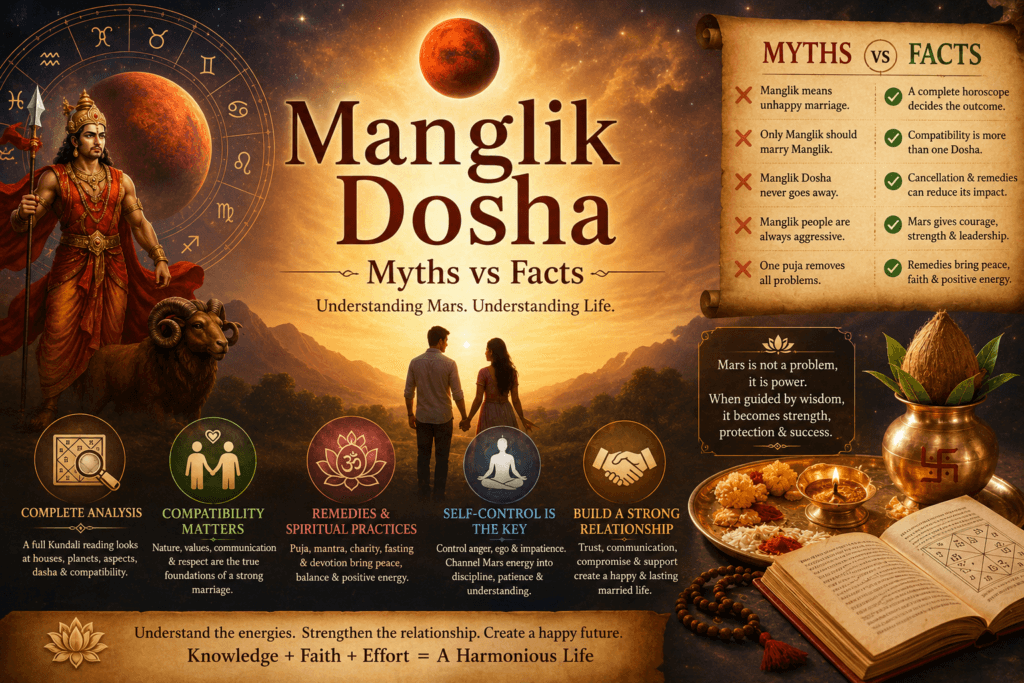
Manglik Dosha Myth #2: You Can Judge It by Looking at One Planet
This is another common mistake.
Someone checks a Kundali.
They find Mars.
They panic.
But that’s not how detailed horoscope interpretation works.
An astrologer may examine Mars in relation to different houses, signs, aspects, and other planets.
Some traditions also assess the condition from the Ascendant, Moon chart, and Venus chart.
Different schools can also differ in which houses they include.
For example, Drik Panchang notes differences between North and South Indian approaches regarding certain houses while also describing commonly used cancellation rules.
This means two people can look at the same horoscope using different simplified rules and reach different preliminary conclusions.
That is precisely why online calculators should not replace a proper interpretation.
The placement is only the beginning.
The real story is in the complete chart.
Manglik Dosha Fact #2: Cancellation Rules Can Change the Interpretation
Here’s where the topic becomes even more interesting.
Many people hear:
“You have Mangal Dosha.”
And immediately assume the worst.
But traditional astrology recognizes various combinations that may reduce or cancel the Dosha.
These rules can involve the position and strength of Mars, other planetary combinations, and the overall structure of the horoscope.
This means a person should never make a major life decision based solely on a basic “Manglik” label.
The important question isn’t simply:
“Am I Manglik?”
The better question is:
“What does my complete Kundali indicate?”
That distinction can completely change the conversation.
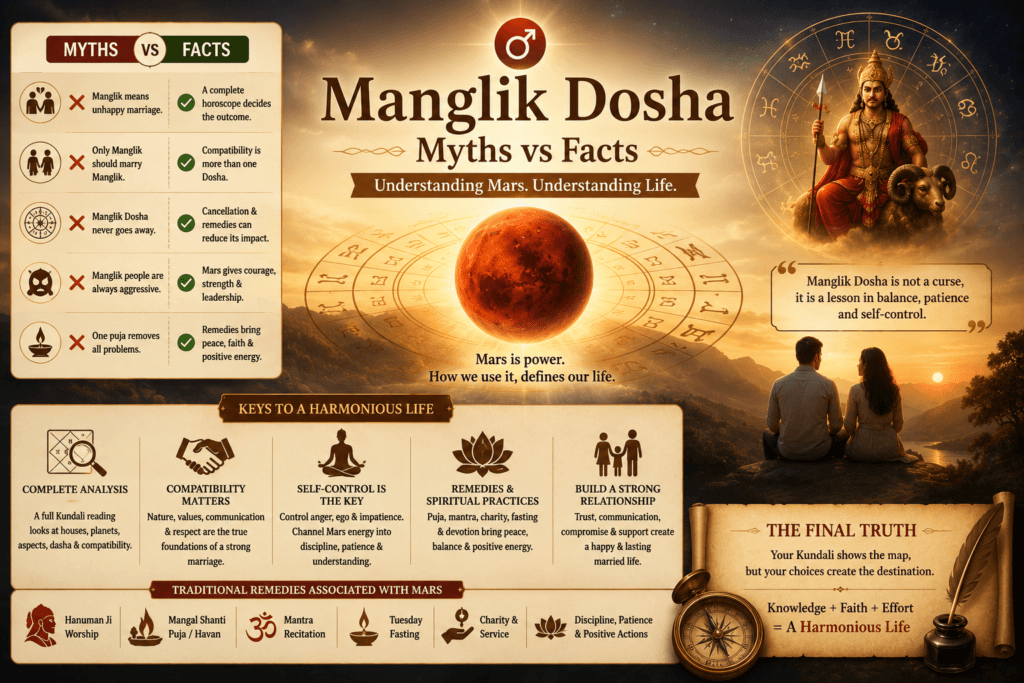
Manglik Dosha Myth #3: Manglik People Must Always Marry Other Manglik People
You’ve probably heard this advice.
“Manglik should marry Manglik.”
But is it that simple?
Traditional astrology does give importance to compatibility between two horoscopes.
Some traditions consider matching two people with similar Mars-related conditions as one possible balancing factor.
However, marriage compatibility involves much more than one Dosha.
The broader Kundali matching process can consider multiple factors.
Nature.
Emotional compatibility.
Communication.
Family dynamics.
Planetary periods.
Health-related astrological considerations.
Financial tendencies.
Long-term compatibility.
And many other traditional parameters.
Therefore, reducing the entire marriage decision to Manglik vs non-Manglik is an oversimplification.
A relationship is lived by two people—not by one planetary placement.
Manglik Dosha: Why Mars Should Not Be Feared
There is something beautiful about understanding Mangal correctly.
Mars is not merely a “problem planet.”
It represents fire.
And fire can destroy…
Or it can cook food.
It can burn…
Or it can provide warmth.
It depends on how it is controlled.
In the same way, strong Mars energy can be viewed as powerful when directed positively.
It can represent courage instead of anger.
Leadership instead of domination.
Passion instead of impulsiveness.
Determination instead of stubbornness.
The real goal is not to fear Mars.
It is to understand it.
The Most Important Question Is Still Waiting…
We’ve already uncovered several misconceptions.
Manglik does not automatically mean an unhappy marriage.
Mars represents powerful qualities beyond relationship challenges.
One planetary placement cannot explain an entire Kundali.
And traditional astrology recognizes circumstances that can modify or reduce the interpretation of Mangal Dosha.
But we’re only halfway through the mystery.
Because the biggest questions are still unanswered.
What exactly happens when Mars occupies the 7th or 8th house?
Why are these houses considered particularly important for marriage in traditional astrology?
Can Manglik Dosha actually be removed?
Which remedies are traditionally recommended?
And perhaps the question people ask most often…
Can a Manglik person have a completely happy and successful married life?
The answers are far more nuanced than the myths suggest.
In Part 2, we’ll explore the most controversial beliefs surrounding Mangal Dosha, the role of Kundali matching, traditional cancellation principles, and the remedies commonly discussed in Vedic astrology.
Because sometimes…
The thing we fear the most becomes much less frightening once we understand it.
The biggest mistake people make with Manglik Dosha is trying to understand it through fear.
One word appears in a Kundali…
And suddenly, an entire future is questioned.
But Vedic astrology is far more detailed than that.
A single planetary placement is only one piece of a much larger picture.
In Part 1, we discovered that Mars represents courage, determination, passion, and action—and that a Manglik indication does not automatically mean an unhappy marriage.
Now, let’s go deeper.
Because the most controversial questions are still waiting.
What happens when Mars occupies the 7th house?
Why is the 8th house considered significant?
Can the effects be reduced?
And are traditional remedies really meant to “remove” a Dosha?
The answers require a closer look.
Manglik Dosha: Why the 7th House Gets So Much Attention
The 7th house holds an important place in traditional Vedic astrology.
It is associated with marriage, partnerships, relationships, and one-to-one connections.
So when Mars is placed here, astrologers may pay particular attention to how its fiery qualities interact with relationship matters.
Mars represents energy.
Action.
Assertiveness.
Passion.
But relationships require something else too.
Patience.
Compromise.
Listening.
Understanding.
This creates an interesting combination.
A strong Mars influence may be interpreted as bringing intensity into partnerships.
That intensity can become passion and courage.
Or, if poorly managed, it may manifest as impatience or conflict.
The important point is this:
Intensity does not automatically mean failure.
It depends on the entire horoscope and the individuals involved.
Manglik Dosha: Why the 8th House Creates More Questions
The 8th house is another placement traditionally considered important when evaluating Mangal Dosha.
It is associated in Vedic astrology with transformation, shared resources, sudden changes, vulnerability, and deeper aspects of life.
When Mars occupies this area, traditional astrologers may examine the chart carefully.
But again…
One placement cannot tell the whole story.
The strength of Mars matters.
The sign matters.
Planetary aspects matter.
The 8th lord matters.
The condition of the 7th house matters.
And the overall compatibility of both horoscopes matters.
This is why a serious astrological interpretation should never be reduced to:
“Mars is here, therefore your marriage will fail.”
Astrology, as traditionally practiced, involves layers of interpretation.
Myth #4: A Manglik Person Can Never Marry a Non-Manglik Person
This belief has created unnecessary fear for countless families.
The reality is much more nuanced.
Traditional horoscope matching may examine whether both partners have similar Mars-related influences.
Some schools consider this helpful in balancing the relationship.
But it is not the only consideration.
A complete Kundali matching process may examine compatibility through multiple traditional factors.
Emotional nature.
Communication.
Temperament.
Family compatibility.
Planetary periods.
The 7th house.
The condition of Venus and Jupiter.
And overall planetary strength.
Therefore, simply finding that one person is Manglik and another is not should not automatically end the discussion.
The entire chart deserves attention.
Fact #3: Compatibility Is Bigger Than One Dosha
Imagine two people.
One has a Manglik indication.
The other does not.
They communicate beautifully.
They respect each other.
Their values are aligned.
Their families are supportive.
They handle disagreements maturely.
Now imagine another couple.
Neither has a Manglik indication.
But they constantly argue.
They don’t communicate.
They don’t respect boundaries.
They cannot resolve disagreements.
Which relationship is automatically stronger?
This illustrates an important point.
Traditional astrology may provide a framework for compatibility.
But a successful marriage also depends on real human qualities.
Respect.
Trust.
Communication.
Patience.
Emotional maturity.
Shared responsibility.
No horoscope can replace these.
Myth #5: Manglik Dosha Can Never Be Reduced
This is another widespread belief.
Traditional Vedic astrology, however, includes various cancellation or reduction principles.
Depending on the astrological tradition being followed, factors such as Mars’ sign, house placement, aspects, conjunctions, planetary strength, and other combinations may alter the interpretation.
This is why two people with apparently similar Mars placements may receive completely different readings.
The word “Dosha” should therefore not automatically be interpreted as a permanent curse.
It is better understood as an astrological condition that requires context.
And context changes everything.
Traditional Remedies: What Are They Actually Meant to Do?
Now we reach one of the most fascinating parts.
If a person is traditionally considered Manglik…
What can they do?
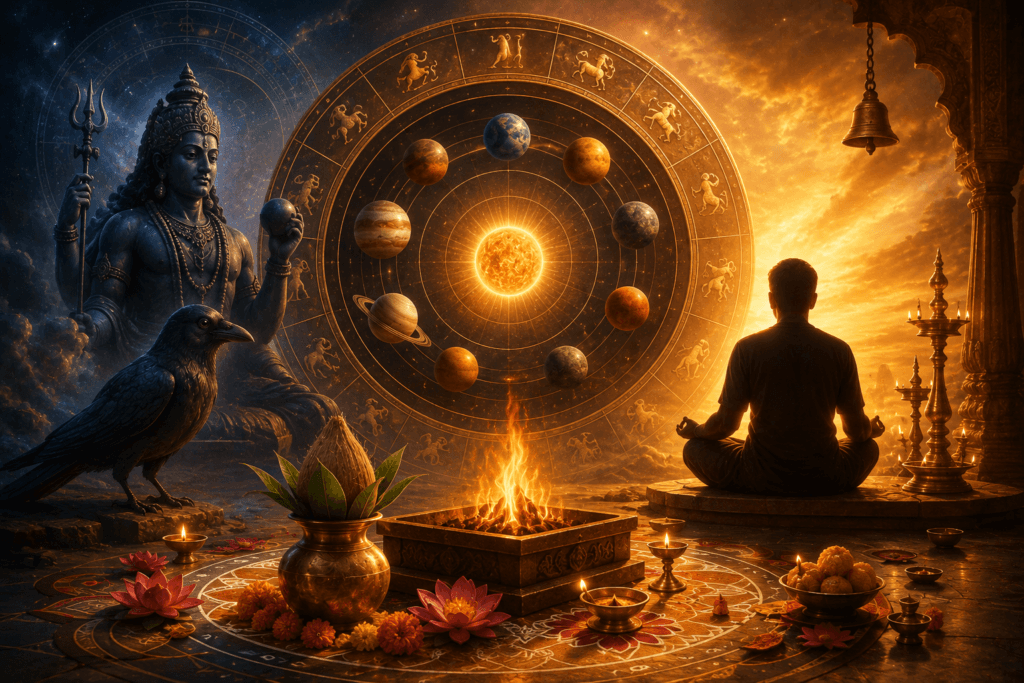
Hindu traditions describe several spiritual remedies.
These may include:
- Mangal or Hanuman worship
- Recitation of traditional mantras
- Tuesday observances
- Charity
- Havan
- Navagraha-related rituals
- Mangal Shanti Puja
- Certain forms of Kundali-based remedial worship
The exact remedy depends on the individual’s horoscope and the tradition followed by the astrologer.
But there is an important distinction.
These practices are spiritual and traditional remedies, not scientifically established methods for changing planetary forces.
They should not replace practical relationship guidance or informed decision-making.
Myth #6: One Puja Automatically Removes Every Problem
This is where unrealistic promises can become dangerous.
No responsible person should guarantee:
“Perform this one Puja and every marriage problem will disappear.”
Traditional remedies are generally understood as spiritual practices intended to seek divine blessings, peace, and balance.
They do not remove the need for communication.
They do not replace compatibility.
They do not eliminate responsibility.
And they certainly do not guarantee a particular outcome.
The healthiest approach is to combine faith with wisdom.
Pray.
Reflect.
Understand the horoscope.
Communicate honestly.
And make decisions carefully.
Fact #4: The Purpose of a Remedy Is Often Bigger Than the Dosha
Think about what happens during a traditional Puja.
A person takes a Sankalp.
They sit quietly.
Mantras are recited.
Offerings are made.
The mind becomes focused.
The family gathers.
For many devotees, this creates a powerful sense of peace.
Even when viewed purely as a spiritual practice, such rituals can encourage discipline, reflection, and hope.
The deeper purpose may therefore be transformation.
Not simply:
“Remove the problem.”
But:
“Help me face life with greater wisdom.”
That is a much more meaningful understanding of a remedy.
Why Mars Can Actually Become a Strength in Marriage
Here’s an idea that rarely gets discussed.
The same Mars energy that is traditionally associated with conflict can also bring extraordinary strengths.
Courage to protect your family.
Energy to work hard.
Passion toward your partner.
Determination during difficult times.
Confidence to make important decisions.
Willingness to take responsibility.
Imagine a person with strong Mars energy who has also developed emotional maturity.
Their assertiveness can become leadership.
Their passion can become loyalty.
Their determination can become stability.
Their courage can become protection.
The planet isn’t necessarily the problem.
How its energy is expressed becomes the real question.
Myth #7: Manglik Means “Bad Luck in Marriage”
This statement is far too simplistic.
A person’s marriage is influenced by countless factors.
Their personality.
Their upbringing.
Their expectations.
Their communication style.
Their values.
Their financial habits.
Their emotional maturity.
Their willingness to compromise.
Even within astrology, a full Kundali contains far more information than one Dosha.
So attaching someone’s entire marital future to a single label can create unnecessary anxiety.
The word “Manglik” should encourage deeper understanding…
Not panic.
The Hidden Lesson of Mars
Perhaps the most beautiful lesson hidden within this entire discussion is self-control.
Mars is fire.
And fire needs direction.
A controlled flame cooks food.
An uncontrolled flame causes destruction.
Human energy works in exactly the same way.
Anger can become courage.
Passion can become dedication.
Ambition can become achievement.
Assertiveness can become leadership.
The goal is not to extinguish the fire.
It is to learn how to control it.
That may be one of the most valuable lessons anyone can take from the traditional understanding of Mangal.
One Question Remains: Can a Manglik Person Have a Happy Marriage?
After everything we’ve explored…
The answer becomes much clearer.
Yes, a Manglik person can absolutely have a happy and successful married life.
A traditional astrological indication does not define someone’s character.
It does not decide whether two people will love each other.
It does not determine how they communicate.
And it does not remove their ability to grow.
A relationship is built every day.
Through patience.
Respect.
Honesty.
Understanding.
And shared effort.
Astrology may offer one traditional lens for understanding compatibility.
But the people in the relationship still have to live it.
The journey began with a simple question:
Does having a Manglik indication really mean marriage will be difficult?
By now, the answer should be clear.
It is not that simple.
Traditional Vedic astrology considers Mars an important force of courage, passion, determination, and action. Certain placements are traditionally identified as Mangal Dosha, but the complete Kundali matters far more than a single label.
In Part 1, we separated fear from fact.
In Part 2, we explored the 7th and 8th houses, compatibility, cancellation principles, and traditional remedies.
Now comes the most important part.
What should you actually do if your Kundali shows a Manglik indication?
Should you worry?
Should you avoid marriage?
Should you only marry another Manglik person?
Or should you approach the situation completely differently?
Let’s uncover the final answers.
Manglik Dosha: What Should You Do After Finding It in Your Kundali?
The first step is simple.
Don’t panic.
A horoscope should be interpreted as a whole.
If someone tells you that you are Manglik after checking one placement, don’t immediately make a major life decision.
Instead, consult a knowledgeable Vedic astrologer who can examine the complete birth chart.
The astrologer may consider:
- Mars placement and strength
- Ascendant
- Moon chart
- Venus
- Jupiter
- 7th house and its lord
- 8th house
- Planetary aspects
- Dasha periods
- Compatibility between both charts
- Traditional cancellation or reduction principles
This broader approach provides far more context.
The word “Manglik” is a starting point.
It should never be treated as the final verdict.
Manglik Dosha: Why Complete Kundali Matching Matters
Imagine choosing a business partner.
Would you look at only one quality?
Of course not.
You would consider experience.
Trust.
Communication.
Financial habits.
Vision.
Character.
Compatibility.
Marriage is no different.
Traditional Kundali matching is designed to examine multiple aspects of compatibility rather than relying on one planetary condition.
This is why families often consult astrologers before marriage.
The purpose should not be to create fear.
It should be to understand potential strengths and challenges.
When approached wisely, astrology can become a tool for reflection rather than anxiety.
Myth #8: Marriage Must Be Cancelled If One Person Is Manglik
This is one of the most damaging misconceptions.
Discovering a Manglik indication should not automatically end a potential relationship.
Imagine two people who genuinely care for each other.
They communicate openly.
Their families support them.
They share similar values.
They are emotionally mature.
Then someone notices a Manglik indication and says:
“This marriage cannot happen.”
Such a conclusion ignores the complexity of both astrology and human relationships.
Traditional astrology itself contains multiple factors that can modify how Mangal Dosha is interpreted.
Therefore, major decisions should never be based on a single label.
Fact #5: A Good Astrologer Looks for the Complete Picture
A responsible astrologer does more than identify a Dosha.
They interpret.
They compare.
They explain.
They provide context.
Most importantly…
They should not use fear to influence a person’s decisions.
If someone immediately tells you:
“Your marriage is doomed.”
“Your partner will suffer.”
“You must perform an expensive ritual immediately.”
Take a step back.
A thoughtful consultation should explain the reasoning behind the interpretation.
It should also acknowledge uncertainty and differences between astrological traditions.
Faith should provide guidance.
It should never become a source of unnecessary fear.
Traditional Remedies for Mangal Influence
If a person wishes to follow traditional remedies, Hindu astrology offers several practices associated with Mars.
These may include:
Mangal Shanti Puja
A ritual performed with prayers and mantras seeking harmony and divine blessings.
Hanuman Worship
Lord Hanuman is traditionally associated with courage, strength, discipline, and devotion.
Devotees may recite Hanuman Chalisa or offer prayers, particularly on Tuesdays.
Tuesday Observances
Some traditions recommend specific forms of fasting, charity, prayer, or disciplined practices on Tuesdays.
Havan and Mantra Recitation
Sacred fire rituals and traditional mantras may be performed under the guidance of a knowledgeable Pandit.
Charity and Service
Helping others is an important part of many Hindu spiritual traditions.
The exact practice should depend on the individual’s circumstances and the tradition being followed.
Why Remedies Should Never Become a Business of Fear
This deserves special attention.
Spirituality should provide peace.
Not panic.
If someone tells you that your future is guaranteed to collapse unless you purchase a particular ritual, be cautious.
No spiritual practice should be marketed through threats.
Traditional remedies are matters of faith and religious practice.
They should be approached with devotion and understanding—not desperation.
A genuine spiritual experience should leave you feeling calmer.
Not frightened.
Myth #9: A Manglik Person Is Naturally Aggressive
Another stereotype needs to disappear.
Astrology describes planetary tendencies.
It does not define someone’s entire personality.
A person with a strong Mars influence may be energetic, ambitious, assertive, competitive, or courageous according to traditional interpretations.
But personality is shaped by many factors.
Upbringing.
Education.
Environment.
Life experiences.
Choices.
Emotional maturity.
Therefore, calling every Manglik person “aggressive” is unfair and inaccurate.
The same Mars energy can express itself as courage.
Discipline.
Leadership.
Protection.
Athletic ability.
Entrepreneurial ambition.
The expression matters.
Fact #6: Self-Control Can Transform Powerful Energy
This is perhaps the most practical lesson in the entire discussion.
You cannot always control what happens.
But you can control how you respond.
Someone says something hurtful.
You can react immediately.
Or pause.
A disagreement begins.
You can raise your voice.
Or listen.
A challenge appears.
You can surrender to fear.
Or take action.
This is where the symbolic meaning of Mars becomes powerful.
Energy without direction creates chaos.
Energy with discipline creates achievement.
The same principle applies to relationships.
Passion needs patience.
Confidence needs humility.
Strength needs compassion.
And communication needs listening.
Manglik Dosha and Marriage: What Really Creates Long-Term Happiness?
Forget the horoscope for a moment.
Think about the couples who stay together for decades.
What keeps them connected?
Usually not perfection.
They disagree.
They face financial challenges.
They experience stressful periods.
They change with age.
Yet they learn how to grow together.
They communicate.
They forgive.
They respect each other’s individuality.
They support each other’s ambitions.
They create trust over time.
These qualities matter enormously in real relationships.
Astrological traditions may offer one framework for compatibility.
But relationships require daily effort.
No planetary placement can substitute for kindness.
A Better Way to Think About Manglik Astrology
Instead of asking:
“Is Manglik Dosha dangerous?”
Ask:
“What does this Mars energy teach me?”
Maybe it teaches patience.
Maybe discipline.
Maybe emotional control.
Maybe courage.
Maybe responsible leadership.
Maybe the importance of choosing a partner who communicates well.
This approach turns fear into self-awareness.
And self-awareness is always valuable.
Astrology becomes less about predicting disaster…
And more about understanding tendencies.
That is a much healthier way to approach any spiritual tradition.
11 Powerful Truths to Remember
Let’s bring the entire journey together.
1. A Manglik indication does not automatically mean an unhappy marriage.
The complete horoscope matters.
2. Mars represents powerful qualities.
Courage, action, passion, determination, and confidence are not inherently negative.
3. One planetary placement is not the whole Kundali.
Multiple factors must be considered.
4. Traditional astrology recognizes cancellation or reduction principles.
The interpretation can change depending on the complete chart.
5. Manglik and non-Manglik marriages are not automatically doomed.
Compatibility involves much more than one condition.
6. Remedies are traditionally spiritual practices.
They should be approached with faith rather than fear.
7. No Puja should be presented as a guaranteed solution.
Prayer can support spiritual well-being, but relationships still require effort.
8. A Manglik person is not automatically aggressive.
Planetary symbolism should never become a stereotype.
9. Self-control is one of the most valuable Mars lessons.
Power becomes meaningful when guided by wisdom.
10. A good astrologer should explain rather than frighten.
Major decisions deserve thoughtful interpretation.
11. A successful marriage depends on people, not labels alone.
Respect, trust, communication, patience, and shared values remain essential.
The Final Truth: Don’t Fear Your Kundali
Your Kundali should not become a source of fear.
It should become a source of reflection.
If you discover a Manglik indication…
Don’t immediately imagine the worst.
Learn.
Ask questions.
Understand the complete chart.
Seek guidance from a knowledgeable astrologer if you follow Vedic astrology.
And most importantly…
Continue living responsibly.
Your future is not defined by one word written in a horoscope.
Your choices matter.
Your character matters.
Your relationships matter.
Your actions matter.
Final Thoughts: Mars Is Fire—Learn to Use It Wisely
Perhaps the greatest lesson hidden inside the Manglik discussion is beautifully simple.
Mars represents fire.
Fire can destroy.
But fire can also illuminate.
It can cook food.
It can warm a home.
It can power a transformation.
The difference is control.
Human energy works the same way.
Anger can become courage.
Ambition can become achievement.
Passion can become devotion.
Confidence can become leadership.
Strength can become protection.
The goal is never to fear your inner fire.
The goal is to learn how to direct it.
That is the deeper lesson behind the myths and facts surrounding Mangal Dosha.
So if someone tells you:
“You are Manglik, therefore your married life will be difficult.”
Remember…
A horoscope is far more complex than a label.
Understand the complete picture.
Approach traditions with wisdom.
Use remedies as spiritual practices if they align with your beliefs.
And never forget the most important foundation of a successful relationship:
Love with respect.
Communicate with patience.
Grow together with understanding.
Because sometimes…
The greatest remedy isn’t changing the stars.
It’s learning how to shine beneath them.
Jai Mangal Dev.