Appearance
Introduction
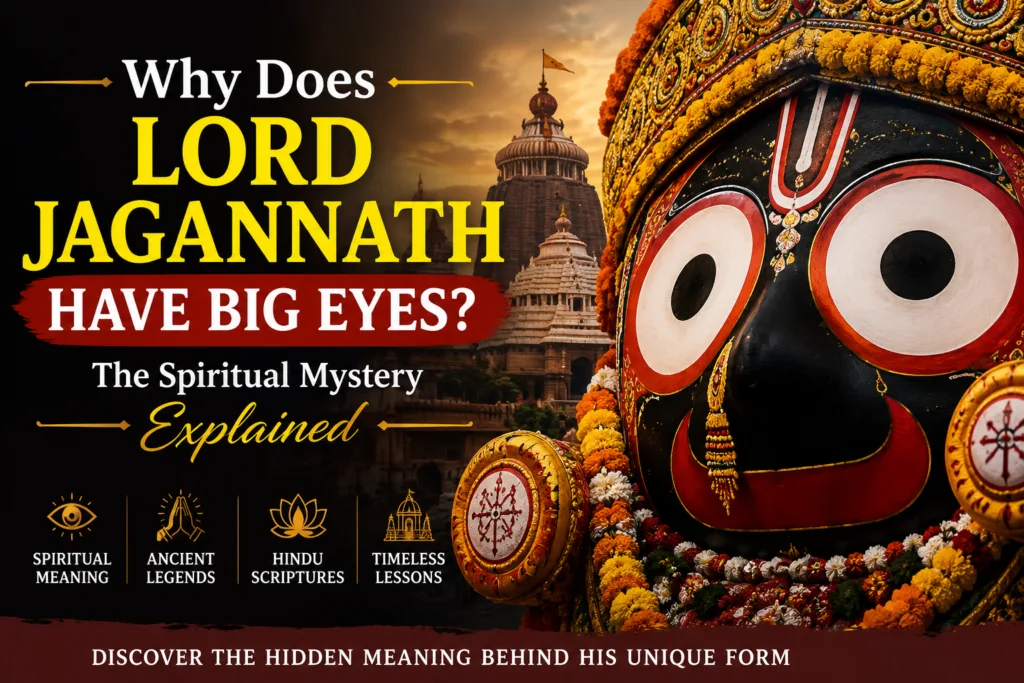
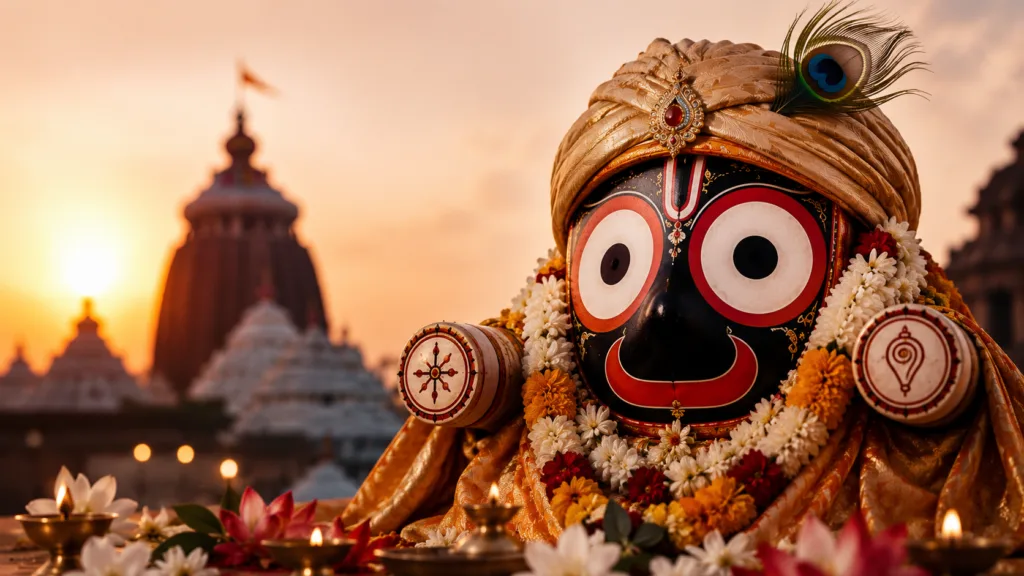
Why does Lord Jagannath have big eyes? This is one of the most common questions asked by devotees and visitors who see the sacred deity for the first time. Unlike most Hindu idols, Lord Jagannath’s eyes are unusually large and perfectly round, while His hands and feet appear unfinished. For centuries, this extraordinary appearance has fascinated millions of devotees and scholars alike. However, these unique features are not accidental—they carry profound spiritual, philosophical, and symbolic meanings that reflect the timeless teachings of Hinduism.
For many devotees, especially those visiting the sacred city of Puri in Odisha for the first time, this unique form raises a natural question:
Why does Lord Jagannath look so different?
Is His appearance incomplete? Was the idol left unfinished? Or is there a deeper spiritual meaning hidden behind this extraordinary form?
The answer lies not only in ancient legends but also in profound Hindu philosophy. Every aspect of Lord Jagannath’s appearance carries symbolic significance, reminding devotees that the Divine cannot be confined by human expectations or physical perfection. His form teaches timeless lessons about compassion, equality, omnipresence, and unconditional love.
In this article, we will explore the fascinating story behind Lord Jagannath’s unique appearance, uncover scriptural references and traditional beliefs, and understand why millions of devotees consider His seemingly simple form to be one of the most powerful representations of the Supreme Lord.
Who Is Lord Jagannath?
The name Jagannath is derived from two Sanskrit words:
- Jagat – the universe or the entire world.
- Nath – Lord, protector, or master.
Together, Jagannath means “The Lord of the Universe.”
Although many scholars and traditions identify Lord Jagannath as a form of Lord Krishna, Vaishnava philosophy also regards Him as the Supreme manifestation of Lord Vishnu, embodying infinite compassion and divine love. His worship has flourished for centuries in the sacred city of Puri, one of the four most important pilgrimage destinations in Hinduism, collectively known as the Char Dham.
Lord Jagannath is worshipped alongside His elder brother Lord Balabhadra (Balarama) and His sister Devi Subhadra. This divine trio symbolizes harmony, family, and the unity of spiritual strength, compassion, and wisdom.
Unlike many temple traditions that emphasize grandeur and exclusivity, the Jagannath tradition is renowned for its inclusiveness. During the annual Rath Yatra, Lord Jagannath leaves the sanctum of the temple and comes out among the people, allowing millions of devotees from all backgrounds to receive His blessings. This act symbolizes that the Lord belongs to everyone, regardless of caste, status, or social identity.
Why Does Lord Jagannath Have Big Eyes? Understanding the Divine Symbolism
Anyone who sees Lord Jagannath for the first time notices several unusual features:
- His eyes are exceptionally large.
- His arms appear short and unfinished.
- His hands and feet are not visible.
- His body is simple and unlike traditional Hindu idols.
- His smile conveys a sense of eternal joy and compassion.
These features are so distinctive that many visitors wonder whether the idol was intentionally left incomplete. According to one of the most cherished legends in Hindu tradition, the answer is both fascinating and deeply symbolic.
The Legend of King Indradyumna and the Divine Sculptor
One of the most popular accounts of Lord Jagannath’s origin comes from traditional narratives associated with the Skanda Purana and regional Odia traditions.
According to the legend, King Indradyumna of Malwa was a devout worshipper of Lord Vishnu. After hearing about the mysterious deity known as Neela Madhava, he became determined to find Him and establish a temple worthy of the Lord.
Despite sending many trusted emissaries across the kingdom, none could locate the sacred deity. Eventually, through divine guidance and unwavering faith, the king discovered the holy site where Lord Jagannath would later be worshipped.
Desiring to create an idol unlike any other, King Indradyumna prayed earnestly for divine assistance.
His prayers were answered when an elderly carpenter appeared before him. According to tradition, this mysterious craftsman was none other than Lord Vishwakarma, the celestial architect of the gods, disguised in human form.
The carpenter accepted the task under one important condition.
He requested complete privacy while carving the idols and instructed the king that no one should open the workshop door until the work was fully completed. If anyone interrupted the process, he warned, the work would stop immediately.
The king agreed without hesitation.
For several days, sounds of carving echoed from inside the workshop. Then, unexpectedly, everything became silent.
No hammering.
No carving.
No movement.
Days passed without any sound.
Queen Gundicha grew increasingly worried. She feared that the elderly craftsman might have become ill or perhaps had died inside the room. Despite the carpenter’s warning, her concern eventually persuaded King Indradyumna to open the workshop door.
The moment the door opened, the mysterious carpenter disappeared.
Inside stood the divine wooden forms of Lord Jagannath, Lord Balabhadra, and Devi Subhadra.
Their bodies were complete enough to inspire devotion, yet their hands and feet were unfinished.
The king was heartbroken. He believed that his impatience had prevented the completion of the sacred idols.
However, at that very moment, a divine voice reassured him that the forms were not incomplete by accident. They represented the Lord’s own chosen appearance and were meant to teach humanity that the Divine transcends conventional ideas of beauty and perfection.
From that day onward, these unique forms have been worshipped by millions as one of Hinduism’s most sacred manifestations of God.
Is This Story Historical or Symbolic?
Scholars generally view the tale of King Indradyumna and the divine carpenter as a sacred traditional narrative rather than a verifiable historical account. Across centuries, different regions and religious traditions have preserved variations of this story, each emphasizing devotion, patience, and surrender to the Divine.
Whether understood literally or symbolically, the legend conveys a profound spiritual truth: God’s perfection is not defined by human standards of physical completeness. Lord Jagannath’s form invites devotees to look beyond outward appearance and recognize the limitless nature of the Divine.
he Hidden Spiritual Meaning Behind Lord Jagannath’s Large Eyes, No Hands, and No Feet
Why Does Lord Jagannath Have Such Large Eyes?
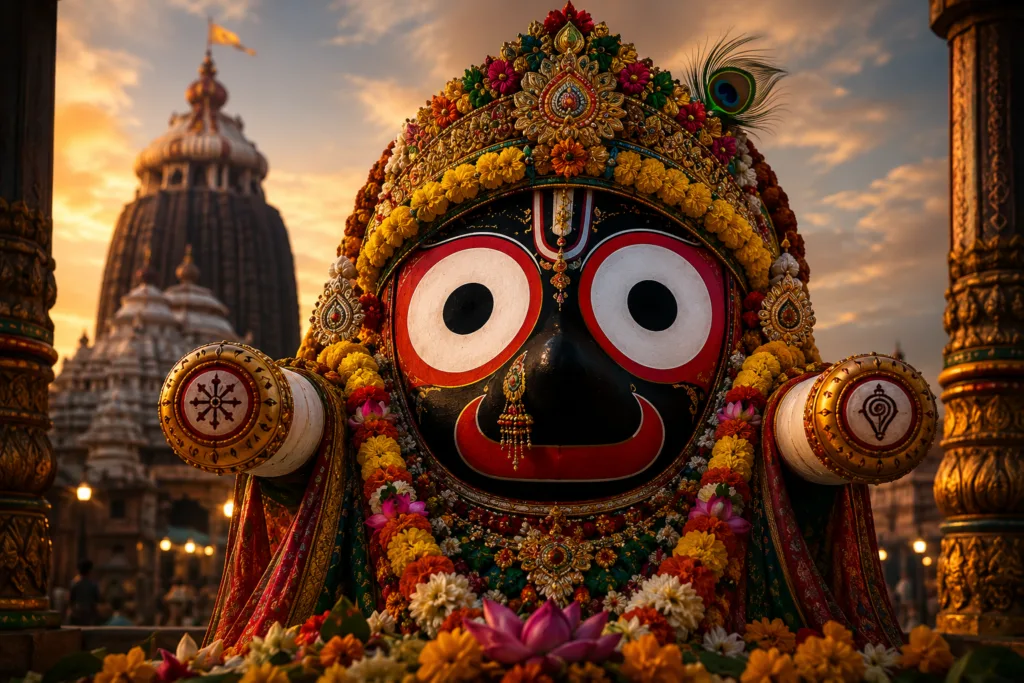
The most striking feature of Lord Jagannath’s idol is His large, perfectly round eyes. They immediately capture the attention of every devotee. Unlike the eyes of other Hindu deities, which are often depicted with eyelids, eyebrows, and expressive details, Lord Jagannath’s eyes are wide open, symmetrical, and seemingly without beginning or end.
At first glance, they may appear unusual. However, according to Hindu philosophy, these eyes carry profound spiritual meaning.
The Eyes That Never Close
One of the most widely accepted interpretations is that Lord Jagannath’s eyes never close because the Divine is always watching over creation.
Unlike humans, who require sleep and rest, God is considered eternal, ever-conscious, and continuously aware of every living being. His watchfulness is not meant to inspire fear but to reassure devotees that they are never alone. Whether someone is celebrating success, facing hardship, or silently praying in the darkest moments of life, the Lord’s compassionate gaze is always present.
This symbolism reminds devotees that divine grace is constant and unconditional.
The Eyes of Infinite Compassion
Another beautiful interpretation is that Lord Jagannath’s large eyes represent boundless compassion.
When devotees stand before the deity in the Jagannath Temple, many describe a feeling that the Lord is looking directly at them. This personal connection is one of the unique aspects of Jagannath worship. His eyes seem to embrace everyone equally, regardless of caste, wealth, nationality, or social status.
This aligns with the very meaning of His name—Jagannath, the Lord of the Universe—who belongs to every soul without discrimination.
His gaze symbolizes acceptance rather than judgment, reminding devotees that sincere devotion matters more than social identity or worldly achievements.
Eyes That See Beyond the Physical World
According to Vedantic philosophy, God does not perceive the world in the limited way humans do. While people often judge one another by appearance, status, or possessions, the Divine sees only the purity of the heart.
Lord Jagannath’s large eyes symbolize this all-encompassing vision. They represent the ability to see beyond external differences and recognize the divine essence present in every living being.
This teaches an important spiritual lesson: if God looks beyond appearances, devotees should also strive to cultivate compassion, humility, and equality in their own lives.
Why Doesn’t Lord Jagannath Have Hands?
One of the most frequently asked questions is why Lord Jagannath appears without fully formed hands.
The answer lies in symbolism rather than physical form.
The Lord Works Without Visible Hands
The Upanishads describe the Supreme Being as one who performs all actions without depending on ordinary human organs. The Divine creates, protects, and sustains the universe through infinite power, not through physical limbs.
Lord Jagannath’s unfinished arms remind devotees that God does not need visible hands to help humanity.
Every blessing received unexpectedly, every act of kindness, every miraculous escape from danger, and every opportunity that transforms a person’s life is often seen by devotees as the invisible hand of the Divine at work.
His form teaches that God’s presence is not limited by physical appearance.
The Invisible Embrace
Many spiritual teachers explain another touching symbolism.
Although Lord Jagannath’s arms appear short, they are believed to be extended spiritually to embrace the entire universe.
Unlike ordinary human beings, who can hug only one person at a time, the Lord embraces every devotee simultaneously.
Whether someone prays in a magnificent temple, a small village, or quietly within their own heart, the Lord’s love reaches them without distance or limitation.
This is one reason millions of devotees experience a deep emotional connection when they stand before Lord Jagannath.
Why Doesn’t Lord Jagannath Have Feet?
Just as His hands are not fully visible, Lord Jagannath is also worshipped without clearly carved feet.
This, too, carries profound symbolism.
The Lord Is Everywhere
In Hindu philosophy, the Supreme Being is omnipresent—present in every particle of creation.
If God exists everywhere, He does not need physical feet to travel from one place to another.
He is already present in every temple, every home, every forest, every river, and every heart filled with devotion.
The absence of feet reminds devotees that the Divine is never confined to a single location.
Then Why Does He Travel During Rath Yatra?
This question naturally arises.
If the Lord is everywhere, why does He leave the temple every year during the Rath Yatra?
The answer beautifully reflects the spirit of the festival.
Lord Jagannath does not travel because He needs to reach another destination. Instead, He comes out to meet His devotees, especially those who may never have the opportunity to enter the temple.
The Rath Yatra symbolizes God’s willingness to step beyond the temple walls and bless every devotee without distinction.
It is a powerful reminder that divine love reaches out first, welcoming all with compassion.
A Form Beyond Human Perfection
Modern society often associates beauty with symmetry, perfection, and outward appearance. Lord Jagannath’s form challenges this perspective.
His unfinished limbs and unconventional features teach that true perfection is not physical but spiritual.
The Divine cannot be measured by human standards of beauty or completeness. Instead, Lord Jagannath invites devotees to look beyond the external and discover qualities such as compassion, humility, surrender, and unconditional love.
This message remains as relevant today as it was centuries ago.
A Lesson for Modern Life
In an age dominated by social media filters, appearances, and constant comparison, Lord Jagannath’s form offers a timeless lesson.
He reminds us that our worth is not determined by how we look, what we own, or how society perceives us. What truly matters is the purity of our intentions, the kindness of our actions, and the sincerity of our devotion.
His large eyes encourage us to see others with compassion.
His invisible hands remind us to serve selflessly without seeking recognition.
His unseen feet inspire us to realize that the Divine is always present, guiding us even when we cannot perceive His presence.
he Hidden Spiritual Meaning Behind Lord Jagannath’s Large Eyes, No Hands, and No Feet
Why Does Lord Jagannath Have Such Large Eyes?
The most striking feature of Lord Jagannath’s idol is His large, perfectly round eyes. They immediately capture the attention of every devotee. Unlike the eyes of other Hindu deities, which are often depicted with eyelids, eyebrows, and expressive details, Lord Jagannath’s eyes are wide open, symmetrical, and seemingly without beginning or end.
At first glance, they may appear unusual. However, according to Hindu philosophy, these eyes carry profound spiritual meaning.
The Eyes That Never Close
One of the most widely accepted interpretations is that Lord Jagannath’s eyes never close because the Divine is always watching over creation.
Unlike humans, who require sleep and rest, God is considered eternal, ever-conscious, and continuously aware of every living being. His watchfulness is not meant to inspire fear but to reassure devotees that they are never alone. Whether someone is celebrating success, facing hardship, or silently praying in the darkest moments of life, the Lord’s compassionate gaze is always present.
This symbolism reminds devotees that divine grace is constant and unconditional.
The Eyes of Infinite Compassion
Another beautiful interpretation is that Lord Jagannath’s large eyes represent boundless compassion.
When devotees stand before the deity in the Jagannath Temple, many describe a feeling that the Lord is looking directly at them. This personal connection is one of the unique aspects of Jagannath worship. His eyes seem to embrace everyone equally, regardless of caste, wealth, nationality, or social status.
This aligns with the very meaning of His name—Jagannath, the Lord of the Universe—who belongs to every soul without discrimination.
His gaze symbolizes acceptance rather than judgment, reminding devotees that sincere devotion matters more than social identity or worldly achievements.
Eyes That See Beyond the Physical World
According to Vedantic philosophy, God does not perceive the world in the limited way humans do. While people often judge one another by appearance, status, or possessions, the Divine sees only the purity of the heart.
Lord Jagannath’s large eyes symbolize this all-encompassing vision. They represent the ability to see beyond external differences and recognize the divine essence present in every living being.
This teaches an important spiritual lesson: if God looks beyond appearances, devotees should also strive to cultivate compassion, humility, and equality in their own lives.
Why Doesn’t Lord Jagannath Have Hands?
One of the most frequently asked questions is why Lord Jagannath appears without fully formed hands.
The answer lies in symbolism rather than physical form.
The Lord Works Without Visible Hands
The Upanishads describe the Supreme Being as one who performs all actions without depending on ordinary human organs. The Divine creates, protects, and sustains the universe through infinite power, not through physical limbs.
Lord Jagannath’s unfinished arms remind devotees that God does not need visible hands to help humanity.
Every blessing received unexpectedly, every act of kindness, every miraculous escape from danger, and every opportunity that transforms a person’s life is often seen by devotees as the invisible hand of the Divine at work.
His form teaches that God’s presence is not limited by physical appearance.
The Invisible Embrace
Many spiritual teachers explain another touching symbolism.
Although Lord Jagannath’s arms appear short, they are believed to be extended spiritually to embrace the entire universe.
Unlike ordinary human beings, who can hug only one person at a time, the Lord embraces every devotee simultaneously.
Whether someone prays in a magnificent temple, a small village, or quietly within their own heart, the Lord’s love reaches them without distance or limitation.
This is one reason millions of devotees experience a deep emotional connection when they stand before Lord Jagannath.
Why Doesn’t Lord Jagannath Have Feet?
Just as His hands are not fully visible, Lord Jagannath is also worshipped without clearly carved feet.
This, too, carries profound symbolism.
The Lord Is Everywhere
In Hindu philosophy, the Supreme Being is omnipresent—present in every particle of creation.
If God exists everywhere, He does not need physical feet to travel from one place to another.
He is already present in every temple, every home, every forest, every river, and every heart filled with devotion.
The absence of feet reminds devotees that the Divine is never confined to a single location.
Then Why Does He Travel During Rath Yatra?
This question naturally arises.
If the Lord is everywhere, why does He leave the temple every year during the Rath Yatra?
The answer beautifully reflects the spirit of the festival.
Lord Jagannath does not travel because He needs to reach another destination. Instead, He comes out to meet His devotees, especially those who may never have the opportunity to enter the temple.
The Rath Yatra symbolizes God’s willingness to step beyond the temple walls and bless every devotee without distinction.
It is a powerful reminder that divine love reaches out first, welcoming all with compassion.
A Form Beyond Human Perfection
Modern society often associates beauty with symmetry, perfection, and outward appearance. Lord Jagannath’s form challenges this perspective.
His unfinished limbs and unconventional features teach that true perfection is not physical but spiritual.
The Divine cannot be measured by human standards of beauty or completeness. Instead, Lord Jagannath invites devotees to look beyond the external and discover qualities such as compassion, humility, surrender, and unconditional love.
This message remains as relevant today as it was centuries ago.
A Lesson for Modern Life
In an age dominated by social media filters, appearances, and constant comparison, Lord Jagannath’s form offers a timeless lesson.
He reminds us that our worth is not determined by how we look, what we own, or how society perceives us. What truly matters is the purity of our intentions, the kindness of our actions, and the sincerity of our devotion.
His large eyes encourage us to see others with compassion.
His invisible hands remind us to serve selflessly without seeking recognition.
His unseen feet inspire us to realize that the Divine is always present, guiding us even when we cannot perceive His presence.
Lord Jagannath’s unique form is far more than an artistic or historical curiosity—it is a profound spiritual message that has inspired millions of devotees for centuries. His large, ever-open eyes remind us that the Divine watches over every living being with compassion and unconditional love. His seemingly incomplete hands and feet teach that God is not limited by physical form; He protects, guides, and blesses the universe through His infinite presence and power.
The legend of the unfinished idol also offers an important lesson for our daily lives. What appears incomplete or imperfect to us may, in reality, be part of a greater divine plan. Lord Jagannath encourages us to look beyond external appearances and focus on qualities such as faith, humility, kindness, and devotion. In a world that often emphasizes perfection, status, and material success, His form gently reminds us that true spirituality lies in the purity of our hearts rather than outward appearances.
The traditions associated with Lord Jagannath, from the sacred Rath Yatra to the mysterious Nabakalebara ceremony, continue to reinforce timeless values of equality, unity, compassion, and surrender to the Divine. Every devotee, regardless of caste, background, or nationality, is welcomed with the same grace and love, reflecting the true meaning of Jagannath—the Lord of the Universe.
Whether you are a lifelong devotee or someone discovering the spiritual significance of Lord Jagannath for the first time, His extraordinary form invites you to see beyond the visible and experience a deeper connection with the Divine. It reminds us that God is always present, always listening, and always guiding those who walk the path of faith with sincerity.
As we reflect on the mystery of Lord Jagannath’s appearance, we realize that His message is timeless: the Divine is not defined by physical perfection but by infinite love, boundless compassion, and the ability to embrace every soul without distinction.